
There’s Something Happening Here
How can we better understand today’s college students and their challenges
⚠️ You have free article remaining.
Log in or become a member for unlimited access.
It’s a warm afternoon in late March 2026, and college students are absorbed in their laptops and smartphones on the sunny patio outside Espresso Profeta, a popular coffee shop near the University of California, Los Angeles (UCLA). Mateo, a UCLA junior, settles into the chair beside me. We chat as he waits for his order: Mexican spiced hot chocolate with oat milk and a shot of espresso. I ask about his experiences at UCLA and his perspective on the country at this moment.
He tells me that much of his time in college has unfolded against a background of constant upheaval. During the spring of 2024, he participated in the Palestine Solidarity Encampment that took place at UCLA, joining protests and demonstrations, which eventually escalated into violent clashes and drew national attention. More than a year has passed since then, but he speaks of the helicopters hovering overhead and the rumors spreading through group chats and social media feeds as though these things happened only days ago.
At one point, Mateo mentions hearing Buffalo Springfield’s 1966 song “For What It’s Worth” at a protest. One line in particular has stayed with him: “There’s something happening here. What it is ain’t exactly clear.”
Current events often overwhelm and confuse him. “Like the song says,” he explains, “I get that something important is happening in the country—but what exactly it is, really isn’t clear to me. Sometimes I want to do something, and other times, I want to stay away from the whole mess.” (All student names in this article are pseudonyms to protect identities.)
Most of today’s college students came of age amid pandemic isolation, numerous mass shootings, intense political divides, economic anxiety, and a crowded, algorithm-driven media environment. As they work toward earning their degrees, they have witnessed a cascade of global and domestic crises, from societal clashes over gender, race, and reproductive rights to the current specter of a broader war in the Middle East.
Those experiences have shaped the values and outlook of many young adults in distinctive ways. Research indicates that members of Gen Z, the cohort born between 1997 and 2012 (which includes most current college and university students), display high levels of empathy and compassion. “Being kind to others” ranks as their second-most important life goal behind physical safety, according to a 2024 UCLA study. Nearly seven in ten say that it is important to defend identity-related causes such as transgender rights, according to recent research from McKinsey & Company. They are also the demographic most likely to join economic boycotts; 53 percent said in a March 2025 Harris Poll that they have participated or will participate in a boycott, compared to 31 percent of the overall adult population. Dissatisfaction with current government policies and opposition to companies rolling back diversity, equity, and inclusion (DEI) initiatives are among their top motivations for boycotting.
At the same time, many Gen Zers are also distrustful of the establishment, cynical about politics, worn down by constant crisis, and increasingly wary of exposing themselves to conflict or saying the wrong thing. They’re facing a mental health crisis characterized by unprecedented rates of anxiety, depression, and psychological distress. According to the American Academy of Pediatrics, 42 percent to 46 percent of young people have been diagnosed with a mental health condition. The result is a generation that is simultaneously outspoken but guarded and surprisingly well informed yet often avoidant. Its members are navigating college life amid extraordinary emotional turbulence.
The popular images of today’s college students often overlook these complexities. News coverage and commentary frequently emphasize academic unpreparedness, dependence on technology and artificial intelligence, and social and political disengagement. While each characterization contains elements of truth, together they reduce a diverse generation to a handful of stereotypes. To understand today’s college students, though, we must look beyond these familiar assumptions and ask broader questions: What does it feel like to come of age in a time of constant uncertainty? How is that experience shaping students’ lives on campus, their relationships with one another, and the adults they are becoming?
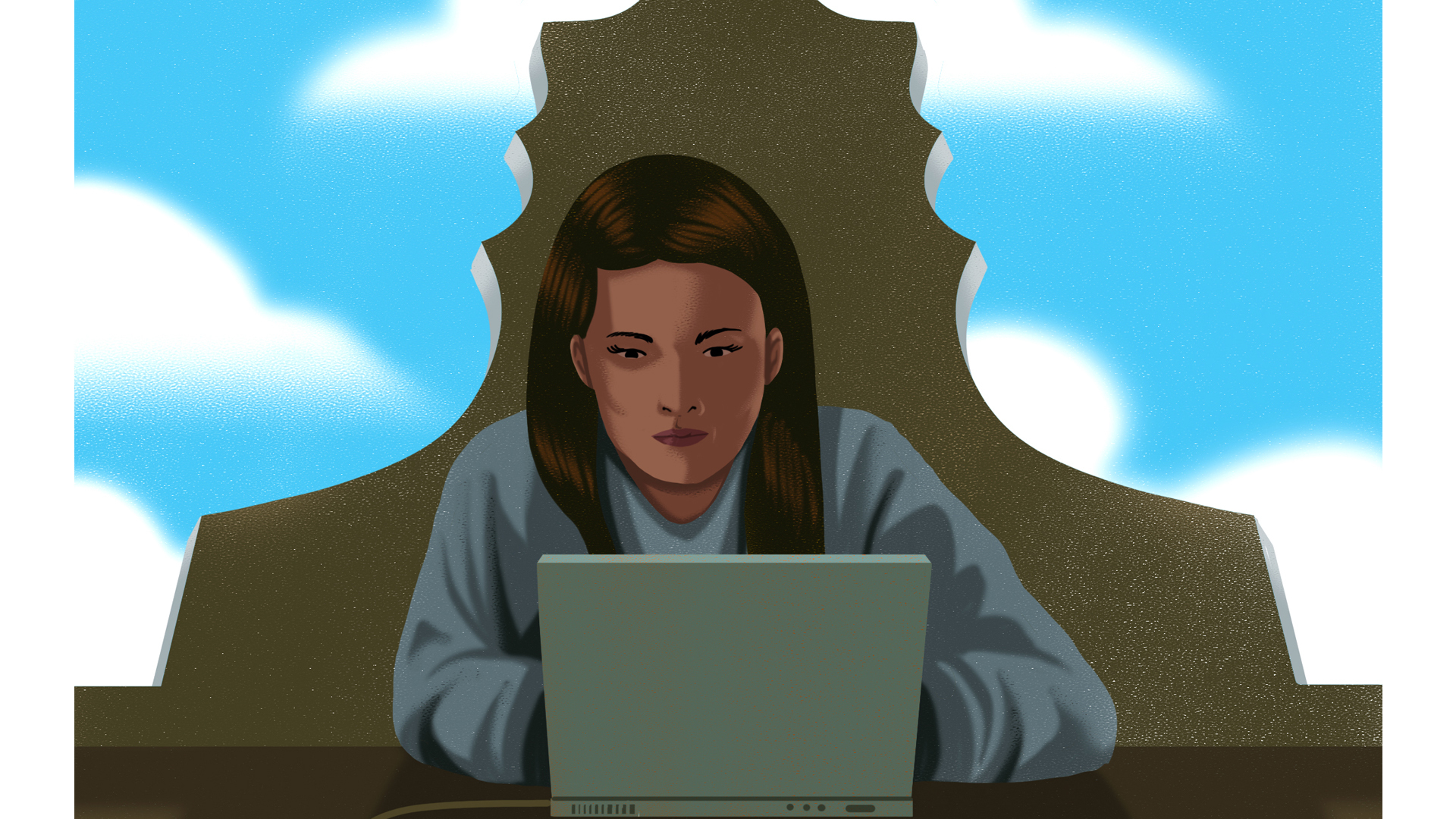
“Our students often express feeling like their future dreams are getting shut down,” says James Stocker, professor of global affairs at Trinity Washington University in DC. “As events unfold in the country, some students feel that options they thought they would have in the future are suddenly no longer available to them.”
In my conversations with students at different types of institutions across the country in spring 2026, I heard a consistent theme. Many students viewed major news events less through the lens of politics or ideology than through questions about their own lives and futures: Will I be able to find a job after graduation with a high enough salary to pay off my student loans? Will I feel safe being open about who I am and what I believe? Will the opportunities I have been working toward still exist by the time I am ready for them?
On February 28, 2026, when the US military began carrying out airstrikes against Iran, many older Americans debated the security and diplomatic implications of the attacks. A lot of college students, however, flooded social media with a different concern: Does this mean there could be a draft?
“My dad served in Afghanistan and my grandfather served in Vietnam, so I grew up with the idea that when your country calls, you answer,” says James, a senior at the University of Alabama, Tuscaloosa, when I meet him over brunch during his communications class trip to Washington, DC, in late April 2026.
The United States does not currently have an active draft—and reinstating one would require approval from Congress and the president. James says he trusts President Donald Trump’s judgment and, should a draft be implemented, would answer the call.
Across the table, Diana, a junior, says the strikes on Iran mirror what she sees as the dehumanization of Palestinians in Gaza. “I feel ashamed of the US and would never fight,” she says. Though, if there is a draft, she says, women should be included.
Darnell, another junior, says that it can be overwhelming to follow the news about conflicts in countries that he has trouble finding on a map. “Before he sends me over there to fight,” he says, “Trump should explain why we’re doing this. He owes me that.”
Despite their disagreements, the students find common ground on one point: They rarely have conversations like this on campus due to their discomfort with discussing controversial or sensitive topics. “Unless a teacher makes me, I don’t normally sit down like this and debate stuff with other students,” Diana says. “My friends and I agree on most stuff, and I just hang out with them.”
Because he supports Trump, James says, people often assume he is racist or unintelligent. “They don’t want to know why I support him,” he says, “and I don’t want to be around them.”
I ask whether the students value conversations like this one—discussions with people with whom they disagree.
“I know this isn’t what you want to hear,” Diana says. “But not really. I already know what I think. I already know that there are people who don’t agree, and usually, I don’t like those people. Why talk about it?”
Darnell says he keeps most of his opinions to himself because he does not want to end up “screenshotted”—having his comments captured and widely shared online—or piled on online.
What these students describe reflects a broader pattern on today’s campuses. More than half (54 percent) of undergraduates report frequently holding back ideas or opinions in class to avoid backlash from professors or peers, according to a 2026 survey by the Foundation for Individual Rights and Expression, College Pulse, and RealClearEducation. The survey also found declining tolerance, with record numbers of students saying it is acceptable to disrupt campus speakers. For the first time in the survey’s six-year history, a majority supported bans on controversial speakers from both the left and the right.
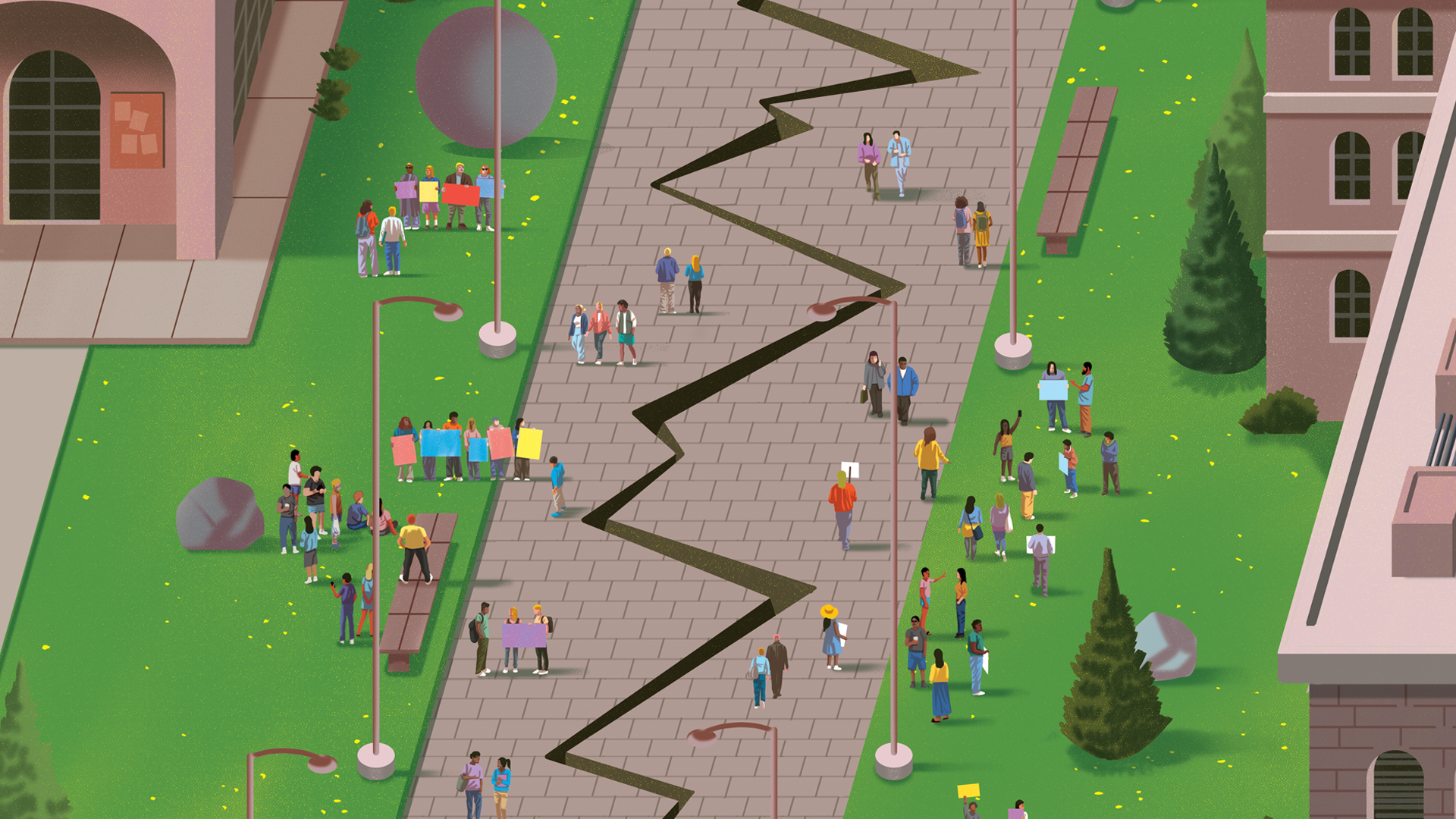
In response to these kinds of student views, colleges and universities have invested heavily in civil discourse programs and initiatives. The Constructive Dialogue Institute alone partners with more than 150 institutions. Yet many students continue to say that it feels risky to express unpopular views on their campus.
Our conversation moves on to classes, internships, and summer plans. Diana checks her phone for an email about housing. She says she limits how much news she consumes to avoid feeling overwhelmed. James mentions finding a job after graduation. The shift in the discussion is abrupt but revealing. The students are not indifferent to politics or world events. They simply carry those concerns alongside the immediate work of becoming adults—finding careers, building relationships, achieving financial stability, and imagining the lives they hope to create.
“Often I just want to figure out my life and get on with it,” James says.
For many students, questions about the future relate strongly to questions of identity and belonging. Over breakfast in Los Angeles in March 2026, Terrance, a senior at the University of Alabama, shares with me that he is visiting the city to begin planning his life after graduation. Yet our conversation keeps returning to Alabama.
Terrance speaks with visible frustration about new restrictions on Black History Month celebrations on campus and the suspension of two student-run publications—one focused on Black culture and student life and another centered on women—as the university quickly moved to respond to the Trump administration’s changes in DEI policy.
“This country was built on hatred and racism. And the racism is still here,” Terrance says. “When history is taught, it doesn’t highlight people of color. They’re not celebrating people like me.” The university’s actions, he says, have left him less hopeful about his future as a Black man.
Faculty members around the country describe hearing similar concerns about belonging as states adopt new restrictions affecting diversity efforts, course content, and campus life. As a result of increased political control over higher education in its state, the University of North Carolina (UNC) System made course syllabi publicly available through searchable databases. Supporters said the move increases transparency, while critics warn it could chill teaching and discussion.
“The speed and direction of these changes came as a shock to many of my colleagues,” says Omar Ali, professor of history and Black Studies and dean emeritus at UNC Greensboro. Faculty members have become more cautious about expressing their views, he says, because they know their classrooms and campuses are under greater public scrutiny. He describes a broader shift in mood, contrasting the optimism and bridge-building he associates with the Black Lives Matter movement with what he sees as a sharp retreat from those efforts.
Kinsley, a junior at UNC Greensboro, however, supports scaling back DEI initiatives and believes the shift has made campus more neutral. She often keeps her views on issues such as affirmative action and systemic racism to herself. “I could always tell when a professor didn’t want me to say certain things in class,” she says.
For Shoshana, a Jewish senior at Tufts University in Massachusetts who has family in Israel, deciding whether to speak openly about her views—or even her identity—has become a question of physical safety. After the October 7, 2023, attacks and the outbreak of the Israel-Hamas War, Shoshana became increasingly guarded. “I was extremely frightened by the political rhetoric from people in my dorm and some of my classes,” she says. “I became very hesitant to mention my connection to Israel. I didn’t always want people to know I’m Jewish.”
Nathan, a senior at Tufts, says he worries his Christian beliefs may be dismissed or stigmatized in academic spaces. He is uncomfortable discussing how his faith shapes his views on social and political issues.
Questions of safety and belonging are also tied to gender. “It’s really hard being trans these days,” says Kaz, a junior at Ohio University. “People don’t get that it affects every facet of my life.”
Lucia, a senior at Scripps College, describes unease over issues of bodily autonomy and womanhood. “I’m often calculating my future choices,” she says. “Post-Roe changed how I think about freedom. It made me question whether my identity as a woman is respected and protected.”
For undocumented students, the stakes are more immediate. One undergraduate at the University of the District of Columbia (UDC) says fear has become the backdrop of everyday life, making it difficult to concentrate in class. “My attention is always somewhere else, checking the news, thinking about my family,” the student says. “I sit in lectures and realize I missed half of what was said.”
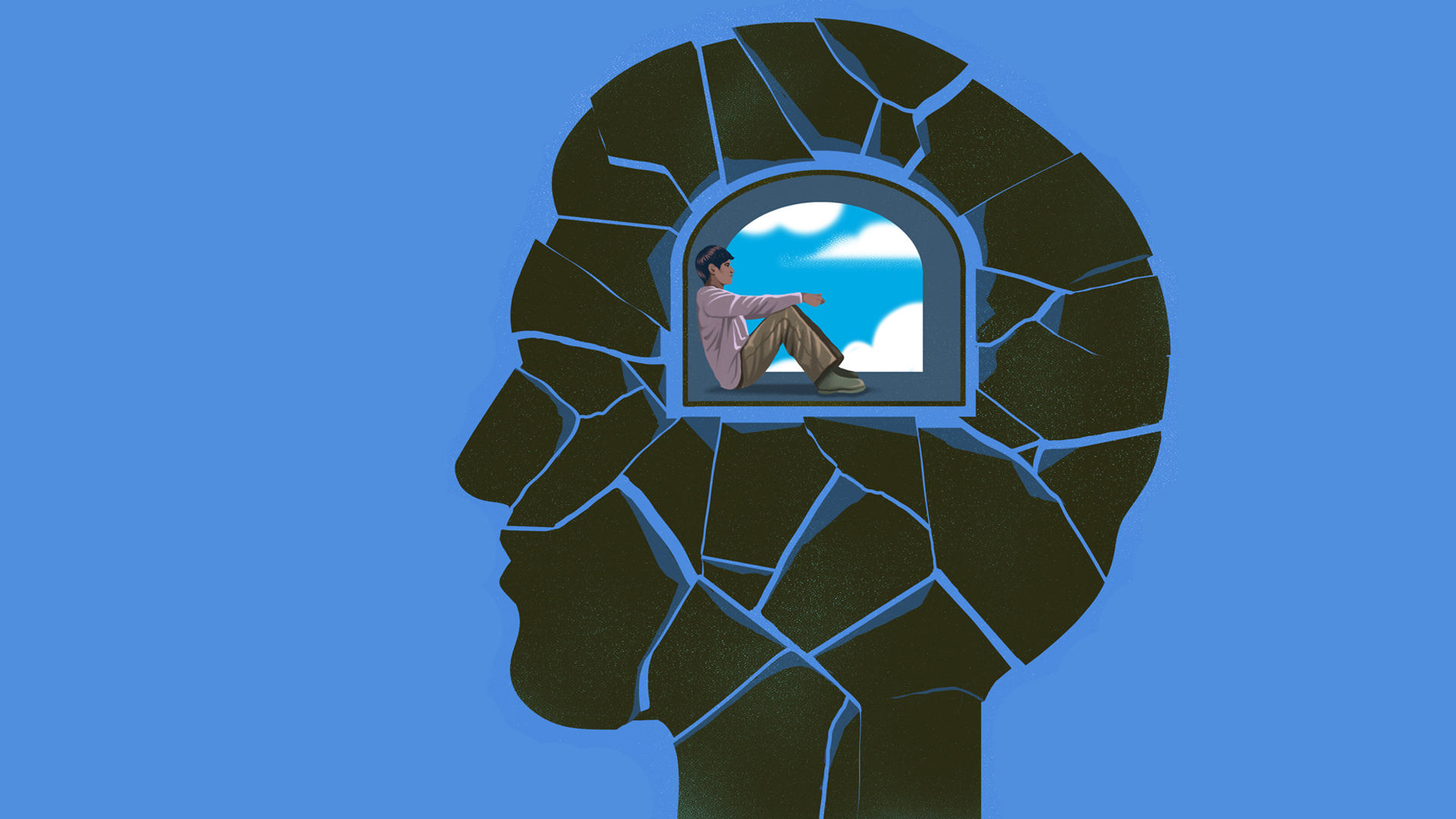
At Trinity Washington, another undocumented student describes a similar experience: “I’m always wondering whether my whole life could change overnight. I study with an eye on the exit.”
Patricia McGuire, president of Trinity Washington, says those fears increasingly shape students’ educational choices. Some have declined research opportunities, conferences, and field experiences because they worry that traveling through airports, train stations, or other transit hubs could expose them to immigration authorities. Trinity’s James Stocker says that the university has expanded transportation options and that faculty members increasingly ask whether students feel safe traveling to off-campus events that once seemed routine.
Although a plurality (47 percent) of young adults opposes mass deportations and aggressive immigration enforcement, according to the 2026 Harvard Youth Poll, students hold a range of viewpoints—and not all think institutions should get involved.
“Laws matter and the government should enforce them,” says Sofia, a UDC student. “At the same time, I also want my school to just stay out of stuff like this.”
Across viewpoints, students consistently describe carefully weighing what to reveal, when to speak, and when to remain silent. For some faculty members, the answer is not to avoid these difficult conversations but to create conditions for students to engage productively with them.
Michael Hoffpauir, a professor of political theory at the University of Austin, argues that reluctance to speak across differences often reflects a broader fear of public judgment and being wrong, especially on questions of morality and identity where disagreement is inevitable. But he believes another outcome is possible: “Once students see that there is a path where the subject itself and our reasoning on it is more important than ‘who’ does the reasoning,” he says, “the fear of saying something of which others might not approve may recede and the desire to know may rise.”
On an unseasonably cold day in late March 2026 at Tufts University, around sixty people crowd into a conference room for Politics and Culture from All Sides, a popular lunchtime series hosted by the Center for Expanding Viewpoints in Higher Education. An event flyer on the door proclaims, “Expanding Viewpoints Starts with You.” The center initiated the program in September 2025 to provide a forum for students, faculty, and staff to discuss contested political, social, and cultural issues.
Eitan Hersh, professor of political science and the inaugural director of the center, begins the session by introducing the assigned reading for today’s meeting: “Yes, Sydney’s Boobs Are Anti-Woke” by conservative writer and political scientist Richard Hanania. After noting that both the title and the piece are “deliberately provocative, a common tactic by right-wing commentators,” Hersh summarizes Hanania’s argument that actress Sydney Sweeney’s public image reflects a broader cultural backlash against progressive politics. He describes the controversy surrounding the essay and then opens the floor for comments.
Students jump in with a range of reactions to Hanania’s assertion that the “woke” era of political correctness is collapsing in favor of a return to traditional unfiltered sex appeal in mainstream media. Some students critique the article for reducing a successful actress to a sexual object. A spirited debate about the definition of objectification ensues.
At one point, Hersh asks a student who disagrees with Hanania to argue the topic from the author’s viewpoint. The student smiles and enthusiastically accepts the challenge. Later, Hersh asks how the article would be received in other spaces like a fantasy sports chat group. A group of male students laugh, and one responds that they’d be making very different comments than ones being made in this room. Participants then break into small groups to further discuss the article.
“This is my favorite space on campus,” a student says after the event. “Even when I feel really angry about the article or someone’s comments, I know I can actually say what I think. In a weird way, it’s crazy fun.”
Another student says she frequently attends but mainly listens. She often journals about the sessions afterward and sometimes even writes short stories inspired by the conversations. “I hear the same things from all my friends,” she says. “I like to come here a few times a month to hear different ideas.”
Hersh believes that many campus dialogue programs place too much emphasis on maintaining comfort and safety instead of encouraging students to critically engage with challenging ideas. “Programs like this at other institutions often have a human-resources feel to them,” he says.
Rather than asking students to speak primarily from their personal identities or experiences, he has designed the series around provocative readings that encourage them to grapple with controversial arguments and ideas. “Our students don’t know what will happen in this space,” he says, “but they know it will be interesting.”
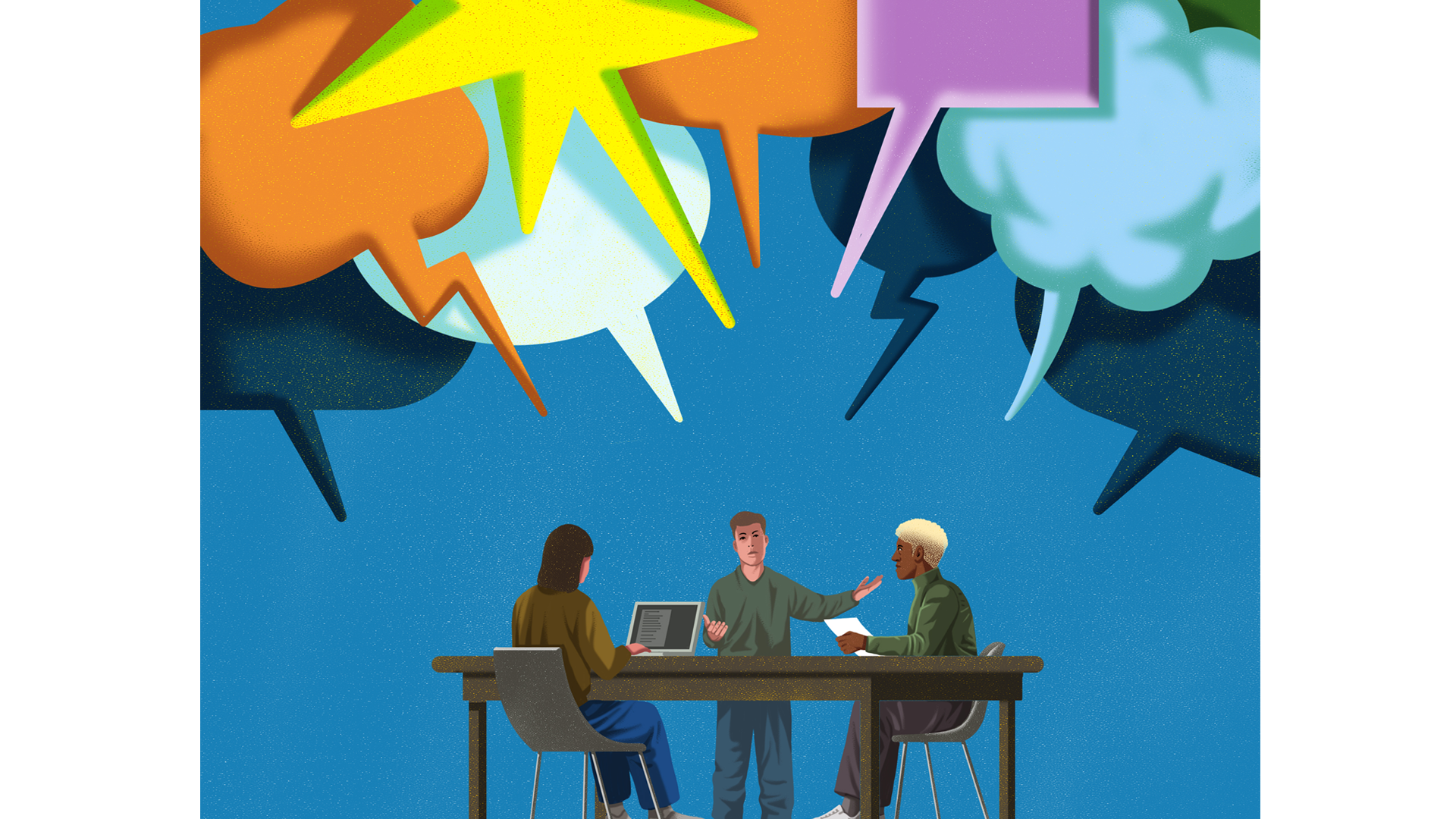
Hersh’s approach reflects a broader argument gaining traction among some academics: that higher education should center classroom and campus discussions on historical texts, rigorous scholarship, and complex ideas rather than primarily on identity. The goal, writes Robert E. Litan, author of Resolved: Debate Can Revolutionize Education and Help Save Our Democracy, is to create a healthy climate of civility and rigorous engagement on campuses and in other learning environments. A focus on ideas rather than identities shifts the emphasis from personal affirmation to intellectual exploration. Litan argues that this lowers the stakes of disagreement and allows students to explore opposing viewpoints without fear of social rejection.
But Heather Nathans, professor of Judaic studies, theater, dance, and performance studies at Tufts, points out that many faculty members also face a practical challenge in the classroom: Regardless of specific pedagogical approaches, teaching certain ideas, texts, or historical topics may carry professional risks. In some states, particularly at public institutions, faculty members report that increased political scrutiny of curricula and classroom content has created concern that course materials or classroom discussions could lead to complaints, investigations, or threats to their positions.
There are also limits to asking students to remain open to all viewpoints, Nathans says: “When discussing and teaching about the Holocaust, for example, we don’t want to validate the Nazi viewpoint.”
In addition, Hoffpauir says, it’s important to acknowledge that it’s OK when a student does not want to engage with a topic. “I respect when a student chooses not to speak,” he says.
Some students are unconvinced that conversations on certain topics are worthwhile—or even possible. “Students who support Israel support genocide,” says Nicole, a junior at UCLA. “I’m not going to talk with someone who’s pro-murder.”
Other students are skeptical that any form of on-campus discussion can solve larger problems. “I’m under attack as a gay man because of who’s in control of the country,” says David, a sophomore at Tufts. “Nothing a professor says or does is going to change that. And there’s nothing a professor can do to keep my undocumented [friends] and their families safe. They can’t help me pay my student loans, and they can’t guarantee I’ll get a job when I graduate.”
After the Politics and Culture from All Sides session ends, students gather their backpacks, toss empty sandwich wrappers into the trash, and filter out into the cold afternoon with no obvious consensus about Hanania’s argument or about whether conversations like this change anything.
Still, for seventy-five minutes that afternoon, they had done something many students describe as increasingly difficult: They stayed in the room together long enough to grapple with ideas they disagreed with, articulate their own views, and engage with people they might otherwise avoid. That may not lower tuition bills, guarantee jobs, or resolve deeper conflicts over identity and belonging, but students say the conversations leave them feeling heard and with a deeper understanding of perspectives different from their own.
“I don’t think anybody’s changing their mind in there,” one student says. “But maybe that’s not the point. You leave realizing people are usually more interesting—and more complicated—than you thought.”
Illustrations by Glenn Harvey
Exclusive Content