
Reading as Resistance
Iranian American author Azar Nafisi on why literature, imagination, and the humanities matter for democracy
⚠️ You have free article remaining.
Log in or become a member for unlimited access.
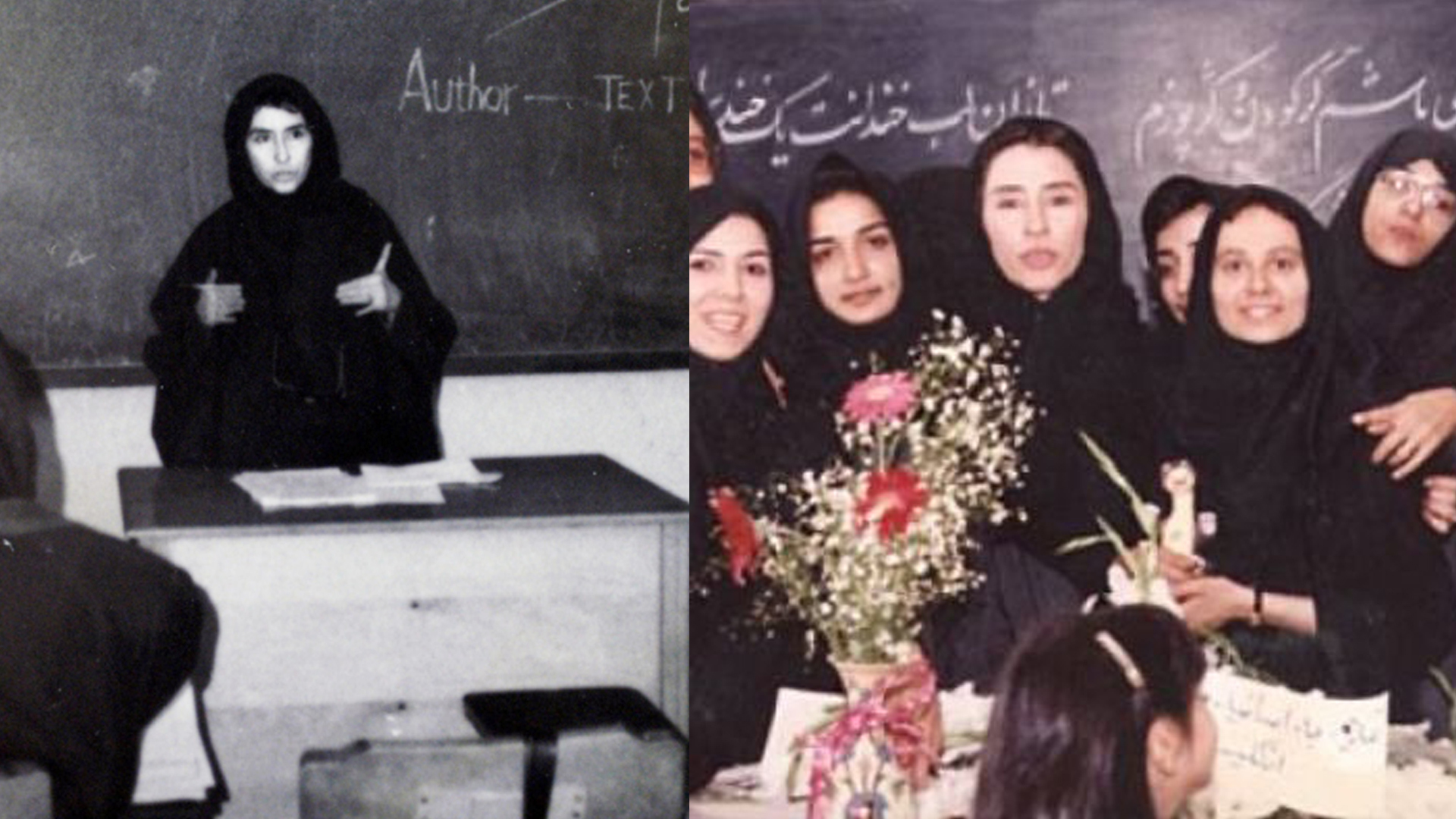
Every Thursday morning for two years in the mid-1990s, seven young women wearing the black robes and hijabs required under Iran’s Islamic Republic quietly made their way to the Tehran apartment of literature professor Azar Nafisi. Each step carried the risk of discovery by neighbors or government informants.
Outside, the Islamic Republic controlled what could be taught, read, written, and discussed. After the 1979 Iranian Revolution toppled the monarchy of Mohammad Reza Pahlavi (the Shah), the Islamic Republic was established. As part of the subsequent Cultural Revolution, the regime closed all universities from 1980 to 1983 and when the institutions reopened, brought them under strict ideological control, banning or heavily censoring many works of Western literature and purging faculty members and students deemed political threats. Women faced sweeping constraints on their daily lives, and those who challenged the government’s mandates—including laws restricting women’s enrollment in fields such as engineering and computer science and requiring gender-segregated spaces on campus—risked harassment, imprisonment, or even death.
More than four decades later, Iran remains under the rule of the Islamic Republic. The current war with the United States and Israel has further compounded the country’s political and social turmoil. The conflict has resulted in massive civilian casualties and displacement, widespread internet and communications disruptions, and increased domestic repression and unrest—exacerbating ongoing struggles over academic freedom, censorship, women’s rights, and freedom of expression.
Yet behind the door of Nafisi’s apartment in the 1990s, another world opened.
There, the women removed their hijabs, poured tea, and spent hours reading and debating works by authors such as Vladimir Nabokov, F. Scott Fitzgerald, Jane Austen, and Henry James. They discussed not only novels but also identity, freedom, truth, and what it means to live authentically under authoritarian rule. These clandestine seminars became the foundation for Nafisi’s bestselling 2003 memoir, Reading Lolita in Tehran, which has been translated into dozens of languages and introduced millions of readers to the power of literature as an act of resistance.
Nafisi, who ultimately resigned from her position at the University of Tehran because she believed she could no longer teach literature freely, immigrated to the United States in 1997. Since then, she has become one of the world’s leading voices on literature, democracy, and freedom of expression. In books including The Republic of Imagination and Read Dangerously, she has argued that great literature cultivates curiosity, empathy, and the democratic imagination precisely because it invites readers to inhabit lives unlike their own.
In the following conversation with Liberal Education, conducted as Iranians were engaged in the ongoing war with the US and Israel, Nafisi reflects on what students and educators in the US and elsewhere can learn from Iran’s long struggle over censorship and women’s rights. She also discusses why authoritarian movements fear literature, how universities can preserve spaces for open inquiry, and what role reading, imagination, and the humanities can play during the current period of deep political division and uncertainty in the United States.
You have written about the ways authoritarian governments fear literature, art, and the imagination. Based on your experiences in Iran, how do literature and the arts shape the experiences of students living under authoritarian regimes?
Many young people in Iran have an intense response to literature and the arts and are deeply engaged with them. Much of that is because the government has tried to take these forms of expression away from them. Students want to deny the regime the power to silence them—to take away their ability to express themselves and to be themselves.
Literature and art are important in resisting totalitarianism for two reasons: They cultivate curiosity and empathy. When you are curious, you seek to understand other people—that leads to empathy. You need empathy in order to survive. Imagination is inseparable from empathy because it allows us to connect with the world and to speak not only about ourselves but about others. That is why contemporary Iranian young people have been so devoted to reading, watching films, and expressing themselves through writing and song.
Can you share the story of a student whose experience illustrates what you mean?
One of my students, Razieh, immediately comes to mind. She attended a small women’s college where I taught modern American fiction after returning to Iran. A strictly practicing Muslim from a very poor family, she was remarkably intelligent and always the first to grasp what I was trying to teach. She fell in love with Henry James, especially his independent female characters, such as Daisy Miller and Catherine Sloper, whose moral courage became a model for her own life.
After the term ended, I saw her only once. We passed each other on the street during a time when people were being seized by the authorities, so you were careful about who you interacted with in public. She gave me a sign that meant, “Don’t talk to me.”
Years later, another former student told me she had met Razieh in prison. They passed the time talking about Henry James and Daisy Miller. Then she paused and said, “Razieh was executed.” I have told Razieh’s story for twenty years to keep her memory alive. To me, she embodies the transformative power of literature.
How would you compare your experiences with students in Iran to what you’ve seen in the United States, particularly when it comes to freedom of expression and the value students place on higher education?
I was shocked when I came back to the United States from Iran in 1997. In Iran, literature and imagination had been a window to the world that had been taken away from my students. But here, I found a different attitude toward knowledge. This is not a critique of the young. It is a critique of people like myself, people who taught them what they should want. They had been told that knowledge is good because it gets you a good job or because it gives arguments to win debates. That mindset has only become more entrenched since then.
If you treat knowledge in this utilitarian way, you will never fully experience what it has to offer. Students need permission to follow their passion and to see knowledge as something larger than utility.
At a time of political division and uncertainty in the United States, how can studying literature help students understand, navigate, and engage with the moment they are living through?
Reading provides us with a democratic mindset. Fiction, if we are talking about a great book, is democratic by nature. Its structure gives voice to different characters who come from different places. Before judging, fiction tries to understand. As readers, we have to understand everyone, including the villain. Ray Bradbury warned that you do not have to burn books to destroy a culture. You only have to get people not to read.
In a democracy, what threatens us is the atrophy of feeling and our sleeping consciousness. As Saul Bellow said, “How will those who survived the ordeal of the Holocaust survive the ordeal of freedom?” Freedom is an ordeal. It comes with responsibilities and choices, and it must be cherished every day. That is why I worry when students say, “I’m not comfortable reading that” or refuse to engage with books or ideas they find offensive. Life is disturbing. We need to be disturbed.
Why do authoritarian governments so often target writers and artists? What makes them so threatening?
Right now, with the rise of authoritarianism around the world, there are writers in Iran and elsewhere who are in prison or who have been killed or executed. Their only weapon is words. So, we have to ask: What makes them so dangerous that powerful governments cannot tolerate them? It is truth. Totalitarian mindsets fear truth because it threatens their control. That is why it is so important to stand up for literature, art, and freedom of expression.
Compared with earlier generations, many of today’s young Iranians, especially women, have taken a more visible role in challenging the status quo. How do you understand that generational shift?
We still need to reflect on the September 2022 “Woman, Life, Freedom” uprising [a women-led protest movement triggered by the death of 22-year-old Mahsa “Jina” Amini while in police custody for allegedly wearing her hijab improperly]. The remarkable thing about this generation is its courage. When I was in Iran, it was considered courageous if a woman let a little of her hair show. Today, young women go into the streets, throw their scarves into the fire, and sing and dance. For nearly five decades, the Islamic Republic has tried to convince women that their independence and identity are illegitimate because these qualities are supposedly Western.
But Iranian women have their own legacy. In the nineteenth century, the poet, theologian, and advocate for women’s rights Tahirih was executed after publicly removing her veil. As she was taken to her death, she declared, “You can kill me as soon as you like, but you cannot stop the emancipation of women.” Iranian women have learned from the West, but the West should also learn from Iranian women. They have realized their power, and I do not believe this movement is going to disappear.
What, if anything, do you think college students in the United States can learn from the experiences of Iranian women?
Students need to revive the progressive and liberal traditions of education in this country. When they ask me, “What can we do?” I tell them, “Create your own book groups. Talk about what you expect from your education. Read history. Read the books you have been warned against, the books that disturb you.” Read authors like Toni Morrison, Zora Neale Hurston, James Baldwin, and Langston Hughes. There’s a reason right-wing groups are trying to censor or ban them. What better way to understand the nefarious influence of racism than to read these writers?
Students need to engage with ideas rather than take the easy way out. They should look at themselves as honestly as they judge others and try to understand other people before condemning them. To change anything, you first have to understand those with whom you disagree. Real change begins with the curiosity to understand others and the empathy to see the world through their eyes.
Many faculty members in the United States say they feel increasing pressure to avoid controversial topics in the classroom. What advice would you offer educators who are trying to preserve spaces for open inquiry?
Educators need to become more involved in the lives of their students. In Iran, almost everything was forbidden, so I had to find different ways to teach. For example, one of my students, the president of the Islamic Student Association, insisted that I should not teach The Great Gatsby because he said it promoted adultery. I knew that arguing with him directly would accomplish nothing, so instead I said, “Let’s put The Great Gatsby on trial.” He became the prosecutor, my students insisted that I serve on the defense, and I invited two of my strongest female students to stand with me. Another student served as the judge. What followed was a real discussion about F. Scott Fitzgerald and why a great writer needs to explore complex truths.
The students liked this approach. Instructors could similarly put Toni Morrison’s novels on trial. But educators cannot do this work alone. They need institutional support, and they need to work together. Organizations such as the American Association of Colleges and Universities can help create the collective support that individual faculty members so often need.
You witnessed censorship firsthand in Iran. What has that taught you about the power of literature and why people seek to suppress it?
The main censor for theater in Iran was a blind man. During performances, someone sat beside him and whispered, “Now the actor is doing this. Now the actress is doing that.” Later, he made playwrights read their work aloud without drama or emotion. For me, the blind censor is a metaphor for authoritarians who refuse to see or tolerate reality and difference.
That can happen beyond Iran. In the United States, there are people who do not want others to read Toni Morrison, precisely because she has the mastery to place readers inside another person’s life. Books connect us to the world. As a girl in Iran who had never left the country, I found Sophocles and read Antigone, written by a man who lived two thousand years earlier. I cried because I felt connected to her. That is the miracle and power of literature.
In the United States, what do you think is driving the current wave of book bans, educational gag orders, and efforts to restrict what teachers and professors can discuss in the classroom?
Totalitarian-minded people understand the threat that a democratic society and a liberal education present to them. When the Islamic Revolution happened, one of the first things the regime did was attack universities and ban books. Ayatollah Ruhollah Khomeini, the founder and leader of the Islamic Republic, said universities were worse than bombs and should be destroyed. Totalitarianism has no limits. It wants to consolidate all voices into one voice.
I remember a student once brought me children’s books in which the censors had put scarves on the female chickens so they would not tempt the male chickens. They censored Olive Oyl from Popeye because she was “living in sin.” Religion had been reduced to putting scarves on female chickens. That is how low we were sinking, and I see signs of that absurdity here as well.
The encouraging thing is that moments of crisis and turbulence can also prompt reflection. People begin asking, “What kind of Americans are we? What kind of Americans do we want to be?” As teachers, writers, and poets, we need to find ways to create communities where these conversations and open debates can flourish.
Lead photo: Alamy/Basso Cannarsa/Opale Photo
Exclusive Content