
Tell Me about Your Board Chair
The president’s partnership with the chair matters even more than you think. Here’s how to ensure a successful relationship.
⚠️ You have free article remaining.
Log in or become a member for unlimited access.
As college and university leaders grapple with major challenges facing higher education—from federal funding cuts and political interference to enrollment declines and artificial intelligence—they must take stock of the different support systems they have to help them navigate these uncertain, turbulent times. One potential source of support in particular deserves close attention: the working relationship between the college or university president and the chair of the governing board. The strength of that partnership significantly affects how well an institution comes through crises that inevitably arise. When the relationship is built on mutual trust and respect, it can strengthen the institution and the board. But when this relationship is marked by distrust, apathy, or conflicting priorities, it can weaken the institution, the presidency, and the board—to the detriment of the entire campus. One does not have to look any further than current news headlines for relevant examples of presidents and their boards working well together—or not.
An institution’s board is responsible for hiring and managing the president, as well as strengthening the institution through strategic planning, oversight, and fundraising. When necessary, of course, the board is also responsible for removing a president from office. The board chair, who is typically selected by its members (not by the president), leads the board and handles substantive communication between the board and the president. The board chair should also be the primary partner and advisor of the president. An effective board chair is a champion for the institution and a key source of counsel during a crisis.
As college or university presidents, we put considerable effort into building a team—our cabinet, administrative staff, and faculty leadership or advisors. Yet we sometimes overlook the board chair as a member of that team, despite how crucial the role is. When my fellow college presidents shared their challenges with me, I would say, “Tell me about your board chair.” Some chairs and leaders played their roles in tandem, working together in synchronicity. Other presidents and chairs engaged in power struggles that turned institutions and organizations upside down. While the president’s relationship with the board chair certainly isn’t the only factor in the president’s success, the reality is that the partnership can make a significant difference in how a presidency—and an institution—fares, for better or worse.
For nearly fifty years, I had the opportunity to experience both sides of the president–chair partnership in various roles, including as a college president for twenty years, first for three years at Deep Springs College in the remote High Sierra desert of California and then for seventeen years at Wilkes College (now Wilkes University) in Pennsylvania. I also served as a board chair for five organizations, including the Frances Perkins Center in Maine, which I guided through transitions in leadership, staff, and focus. Whether as a president or board chair, I had to stay attuned to the nuances and dynamics that needed to be navigated with my counterpart. Here I offer key lessons from my own career in the hopes that what I have learned can help current college and university presidents as they respond to the threats and challenges facing higher education today. While shaped by my experiences at private colleges with an endowment and board of trustees, these lessons are applicable—perhaps even more so, given the political dynamics at play—to institutions with other types of governing boards, such as a board of regents overseeing a public university system.

Get to know your board chair and establish a candid relationship.
Building a strong partnership between the president and chair requires specific elements, which can be added and improved on at any point. A president may work with multiple board chairs, and a board chair may work with more than one president, so it’s important to start the process anew whenever a transition in leadership occurs. Cultivating this partnership includes:
A close relationship. Carve out time to spend with your chair in a mix of formal and informal settings. Board meetings alone do not provide enough interaction to build the trust that must anchor the partnership.
Communication. Stay in frequent contact through updates and regular check-ins. This helps prevent surprises that can undermine trust. Presidents and chairs will need to determine how and when they prefer to communicate in their partnership and how their support staff facilitate such communication.
Candor. The president and board chair must develop the ability to hold frank, open discussions regarding the institution’s strengths, weaknesses, opportunities, and threats and to feel comfortable raising uncomfortable issues (think budget concerns, faculty tensions, and declining enrollment). If they can’t have those conversations with each other, how can they be expected to have them with the larger board, campus, and community?
Shared goals and priorities. Focus on specific shared goals and priorities rooted in the institution’s mission, such as developing a new academic program, improving campus housing, and playing a leadership role in the local community. If the president and chair don’t currently have a good working relationship, identifying these shared priorities can help establish common ground.
When I began my tenure as the president of Wilkes College, the board asked me to select the next board chair—a significant, and unusual, vote of confidence. I chose Pattie Davies, who had served as the chair of the presidential search committee, to become the college’s first female board chair. Davies and I had already had extensive candid conversations about the challenges facing the college, including a bleak financial outlook, student recruitment pressures, and tensions between the board and faculty over reviewable tenure. Together, we established a series of shared goals that defined the first few years of my presidency. She also tasked another board member with organizing numerous social events so that my wife, Jane, and I could get to know the rest of the board, community members, and local leaders—relationships that would prove invaluable over the next seventeen years.

Prioritize financial expertise.
The president and chair must make financial planning and management a top concern. Keep in mind the following:
Financial expertise. One starting point is to evaluate the financial experience that both the president and board chair bring to the table. If neither person has a strong professional financial background, it is imperative that they make financially savvy leaders part of the top-level teams in the administration and on the board and that those teams are in regular communication with the president and chair.
Data. It is crucial to establish data systems that make relevant information available for analysis and sound decision making. This includes data related to the budget, financial aid, student recruitment and retention, and, if applicable, the endowment.
Transparency. The president, chair, and relevant board committees need regular updates and access to data, which inform discussions about such questions as: What are the institution’s current short-term and long-term financial outlooks? What are some shared fundraising needs and opportunities? What are current threats to the institution’s financial health?
Risk assessment. New investment opportunities and ideas are likely to arise, many of which will be inherently risky. These might include creating a new academic program or starting a major construction project. To effectively evaluate these risks, the president and board chair will need to work together and in partnership with other board members to assess new opportunities as well as conflicts of interest and the board’s appetite for risk.
Early in my tenure at Wilkes, I took key steps to address the budget problems. This started with my gaining full access to information about the college’s finances. Unfortunately, the administrator who oversaw financial operations resisted giving me the information, despite multiple requests. I knew that without the data, I would not be able to make informed decisions regarding the college’s financial problems. I decided to fire him partway through my first year, which was a tough—but necessary—action. As we restructured the leadership team, I created a new position, vice president of business affairs, which had significant financial planning and oversight responsibilities. I received the full support of Davies and the rest of the board in both of these decisions, strengthening my hand as we took on the budget challenges.
In addition, Davies and I identified major priorities for the college, including rebuilding the college’s dilapidated gymnasium. We hosted my first board meeting at the gymnasium to demonstrate the urgency of the project. Our plan worked. By the end of the meeting, the board had committed to a capital campaign to raise funds for the building. We ultimately built a state-of-the-art conference center and gymnasium, which provided space for athletics, commencement, performances, and other events.

Build a stronger board together.
The president and board chair can strengthen the overall board through engagement with current members and, where relevant, recruitment of new members, developing a deep bench of future board leaders. Key pieces of this choreography include:
Orientation. Provide orientation and guidance for new board members, some of whom may be serving on their first board, such as a special welcome meeting where members can learn more about the board’s role and operations.
Engagement. Involve the board members more directly on campus, through meetings with students, invitations to campus events, and opportunities to contribute their expertise on board committees.
Professional development. Provide board members with resources related to serving on college and university boards. These might include relevant memberships, subscriptions, or conferences.
The president and board members should regularly evaluate how well the board is supporting the institution’s strategic plan and goals. Is the board making the most of its members’ talents and skills? Do the board’s committees and programs reflect the institution’s priorities and most pressing needs? In what ways is the board supporting the institution’s mission?
In cases where the board members are recruited and not appointed, the president and chair should strategically add members who will bring new energy, ideas, and expertise. While this recruitment is primarily the chair’s responsibility, the president can identify potential members and support these efforts. Fundraising potential is one consideration, but remember to look for new members who are passionate about the institution (including alumni) and have experience in strategic areas, such as finance, technology, data analysis, priority academic areas, and artificial intelligence. Overall, you want to bring on diverse perspectives that can strengthen the institution.
In working to develop a bench of possible future board chairs, it’s important to select board committee chairs who show leadership potential. When this type of long-term planning does not happen, the choices for future board leaders may be limited, especially in times of transition, crisis, or unexpected turnover, leaving both the board and the institution in a vulnerable position—a lesson I learned early at Deep Springs College when my very first board chair died unexpectedly during my very first year as a college president. It was a difficult loss to absorb, but I was fortunate that a strong leader stepped in as the new chair. He proved to be a wise mentor, and he helped me understand the value of the president’s relationship with the chair early in my leadership experience.
During my tenure at Wilkes, I worked closely with several board chairs to engage, support, and develop the overall board. We brought more Wilkes alumni on as board members, who often proved to have particularly helpful insights and ideas, such as the alumna who helped launch a new community service initiative on campus. A few of our alumni also went on to serve as board chairs after my presidency.
My board chairs at Wilkes also provided the leadership needed to fundraise for ambitious projects that included new academic programs, physical facility expansion, student life and engagement initiatives, and the transition from college to university. The board was crucial in approving and funding a new doctorate of pharmacy program, a major commitment of the institution and one of the first doctoral programs in northeastern Pennsylvania.

Prepare for the next crisis.
While no one can predict each twist and turn an institution will face (especially in this current climate), preparation goes a long way in allowing the campus leadership team and board to address challenges that arise. When a crisis hits the institution—be it a threat to the institution’s accreditation, a budget shortfall, or a breach of campus safety—the president will have to quickly determine who needs to be part of the response team. In addition to other administrators, staff, and faculty, ideally the president should be able to count on the board chair as part of that team. An effective chair will provide counsel while also identifying which board members can lend support given the circumstances. One challenge we faced in the last years of my Wilkes presidency was a significant decline in enrollment. Our chair asked one of our trustees, a member of a major Wall Street investment bank, to helm a special recruitment and retention task force to address the issue. After a lot of hard work by the board, administrators, and staff, we developed a plan—and it worked. Both our enrollment and financial outlook improved, thanks to the insights of this talented board member.
Sometimes, the crisis facing the institution is a crisis in leadership, such as a president who is struggling or a board chair who is moving aggressively to make big changes independently of the president. The inability of the president and chair to work collaboratively can severely undermine the institution, which may result in the end of a president’s tenure or a period of widespread instability. Occasionally, board members will quietly approach the president with their concerns about the chair. While all parties should assiduously work to avoid such situations, candid conversations between the president and other leaders on the board may be required if the chair is a liability to the institution. When the partnership between the president and chair is counterproductive or even dysfunctional, with a breakdown in communication and trust, it may be time to get additional input, whether from internal or external sources, on a possible path forward.
As it turned out, the relationship I had with my last board chair at Wilkes was the most challenging. Shortly after he started in that role, Wilkes began its ten-year reaccreditation process. While our enrollment outlook remained positive, other tensions on campus contributed to a negative environment for faculty–administration relations, which became a target during the reaccreditation process. The accreditors recommended that my presidency be evaluated. Not wanting to be a distraction, I discussed the matter with Jane and decided that I would retire at the end of the following year. Against this backdrop, our new board chair jumped into his role with gusto, having recently retired. He eventually took over the accreditation process and set up an office down the hall from my own, exercising daily oversight of me and my staff in my final year. It was a taxing situation during what was already a challenging year, and one that I am certain other board chairs would have handled differently. But more broadly, the board, campus, and community remained supportive throughout my remaining time as president; the board surprised Jane and me by naming a new classroom building on campus for us and naming a gallery in the building for Jane shortly before the end of my presidency.
While I had not originally been expecting to leave Wilkes when I did, my decision made it possible to accept a new opportunity that soon came my way: I was offered the presidency of the Franklin and Eleanor Roosevelt Institute in Hyde Park, New York, which at the time focused on sustaining the Roosevelt legacy through programming and outreach. A significant part of that job involved working with the organization’s high-powered board and two co-board chairs: one who had founded the organization and was still deeply involved in management decisions and Anna Eleanor Roosevelt, a granddaughter of Franklin and Eleanor Roosevelt. Later, I became involved with other groups working to preserve the legacy of the New Deal, including the Frances Perkins Center in Newcastle, Maine, where I served as a board chair for an extended period of time. (I had known Perkins, FDR’s secretary of labor and the first female presidential cabinet member in US history, as a graduate student.) This proved to be a dynamic time for the organization as it transitioned from a board-led organization to a staff-run organization, and I did my best to clarify the role of the board during that change, as well as to support the leaders of the organization over time. Today, the executive director and board chair have a positive working relationship, which has been gratifying and crucial now that the Perkins homestead has been named as a national monument and jointly managed by the National Park Service—a much more public and visible role for the organization than ever before.
These later experiences underscored for me the essential role of the president and board chair partnership and the ways that this relationship can affect the rest of the institution far into the future. I share these lessons learned and recollections with the hope of providing some strategically useful ideas for presidents and board chairs who are navigating the shifting landscape in higher education today. I have been inspired and heartened by the courageous decisions I have seen these leaders making, and to all of you I say, “Steady on.”
Serendipitously, my successor at the Roosevelt Institute, Andrew Rich, recently spoke about his outgoing board chair at the commencement of Franklin and Marshall College, where he is now president. His remarks encapsulate what a chair–president partnership can mean for an institution when it’s working well. Of the outgoing chair, Eric Noll, Rich said, he “knows our history, he knows our people, he knows our values, he knows our aspirations, and he has been an extraordinary mentor and guide for me in learning a place that has meant so much to him over the course of his life.”
Illustrations by Tavis Coburn
A Leader and Mentor
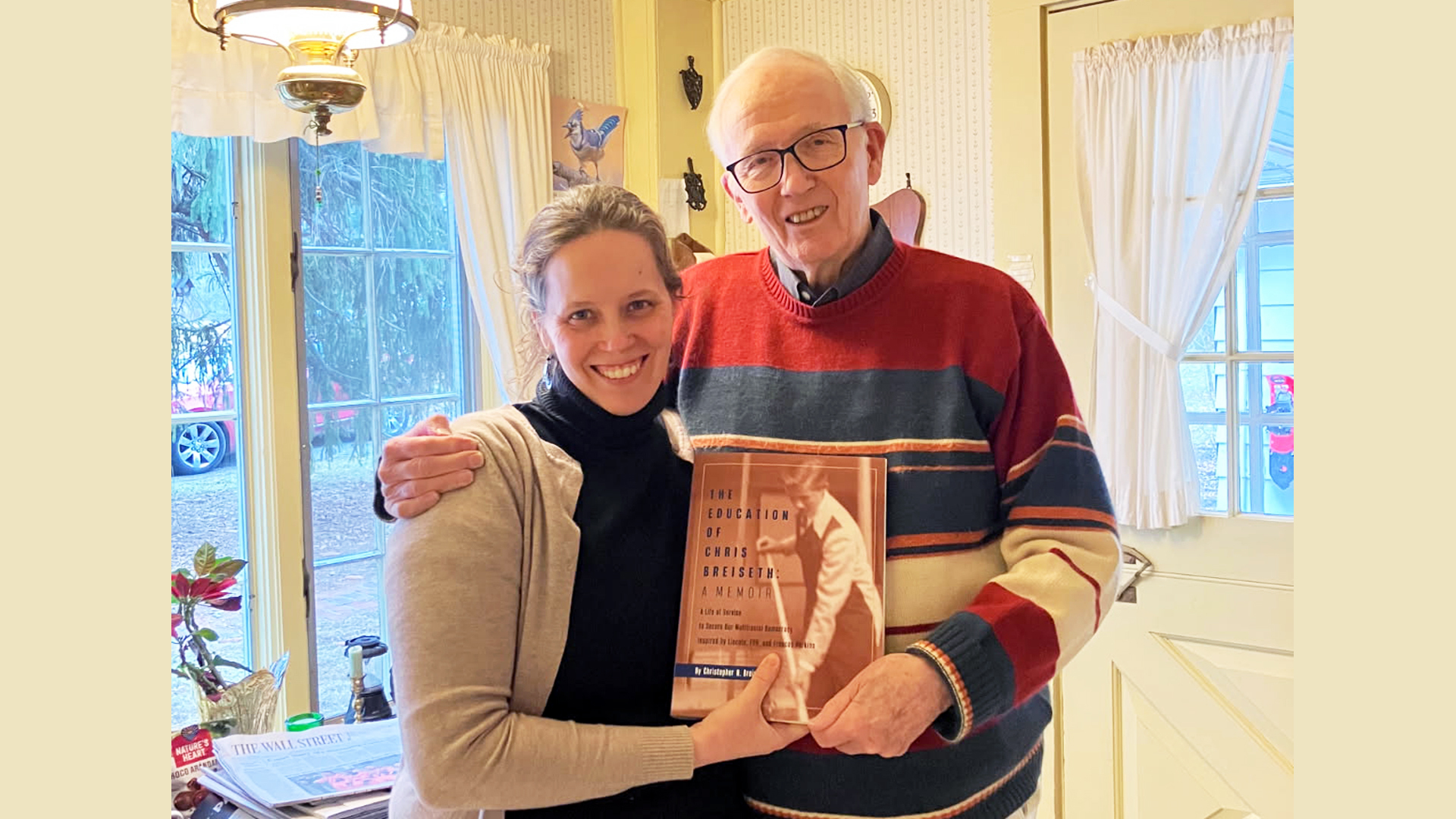
Christopher N. Breiseth (October 6, 1936–June 27, 2026) was president of Deep Springs College from 1980 to 1983 and Wilkes University from 1984 to 2001. He served as president of the Franklin and Eleanor Roosevelt Institute from 2001 to 2008 and was also board chair of the Frances Perkins Center. A mentor and friend to generations of students, faculty, and staff, he chronicled his experiences in a recently published memoir, The Education of Chris Breiseth: A Life of Service to Secure Our Multiracial Democracy Inspired by Lincoln, FDR, and Frances Perkins. He co-wrote this article with his youngest daughter, Lydia.
Exclusive Content