
The Road to the Stars
Five out-of-this-world facts about campus astronomical observatories
⚠️ You have free article remaining.
Log in or become a member for unlimited access.
On a normal nighttime observatory tour at George Mason University, I would be gazing through a telescope, marveling at Jupiter. But tonight, alas, our celestial views are foiled by the eternal enemy of Earth-based astronomy: clouds. The observatory dome is closed, and I glare with irritation at the gray sky above the Fairfax, Virginia, campus.
Yet the evening is surprisingly stellar. The real stars, I discover, are the tour’s two enthusiastic student guides. Gabby Whitefield and Aarshiya Singh show me images from the telescope’s camera on a monitor in the observatory’s dark control room, and they gush at their favorite nebulae and distant galaxies. Later, when we enter the observatory itself, they tell me about the telescope—it’s tied for second largest on the East Coast—and I ask what inspired them to major in astrophysics. For Whitefield, it was the 2014 sequel of Cosmos, hosted by astrophysicist Neil deGrasse Tyson.
“From the first episode I was like, whatever that guy does, I want to do, too,” she says.
Singh, who began college as an economics major, was similarly fascinated by the universe as a child.
“I had this thought process. It was like, I live in Mumbai, which is a city in India, which is a country on the Earth, which is in our solar system, which is in the galaxy. . . . I would genuinely give myself, like, depersonalization from just thinking about that,” Singh says. “But over the years, it became more exciting than scary. And that’s why I switched my major. I wanted to do something that I cared about. I had flashbacks from middle school, high school, when I would say to my friends and my family, ‘You know, if I could do anything, it would be physics.’ ”
That passion for big concepts may be what’s luring students like Whitefield and Singh to astrophysics. US institutions awarded 982 astronomy and astrophysics bachelor’s degrees in the 2023–24 academic year, the most on record and a 200 percent increase since 2008–9, according to a September 2025 report from the American Institute of Physics.
“It’s a rapidly growing major,” says Buell T. Jannuzi, director of the Steward Observatory and head of the Department of Astronomy at the University of Arizona (UA). “Thirty years ago, if you said you had a degree in astronomy, you’d hear, ‘What’s that? Astrology?’ But now [graduates] are sought after because they have good math, computing, and physics skills, and they’ve gotten research experience where they work on a problem in its entirety. They make good program managers, systems engineers, and leaders.”
The allure of astronomy is drawing the public to observatories as well. George Mason welcomes around 2,500 visitors each year for public events involving the observatory; larger facilities such as the McDonald Observatory in Texas receive seventy-five thousand annual visitors. The appeal is universal. We crave not simply knowledge but wonder—the chance to ponder cosmic mysteries, to seek astonishment and awe, to fathom our amoeba-like existence in an unfathomably large universe. That sense of reverence may be even more essential in our current time of division, uncertainty, and political discord. Astronomical observatories allow us to see beyond our politics and daily headlines and to put our lives—and our world—in perspective.
So, let us celebrate the emotional and educational power of observatories. Here are five things you may not know.
1 Academic observatories predate the Civil War.
As early as 1820, Thomas Jefferson was developing plans for an observatory at his soon-to-open University of Virginia. The single-room brick house that debuted in 1830—four years after his death—may not have met Jefferson’s usual grand architectural standards, but its small telescope peered toward the heavens.
The oldest extant observatory in the United States belongs to Williams College, a private liberal arts college in Williamstown, Massachusetts. Williams’ Hopkins Observatory opened in 1838 and welcomed Ralph Waldo Emerson as a guest in 1865.
“What is so good in a college as an observatory?” Emerson wrote of his experience.
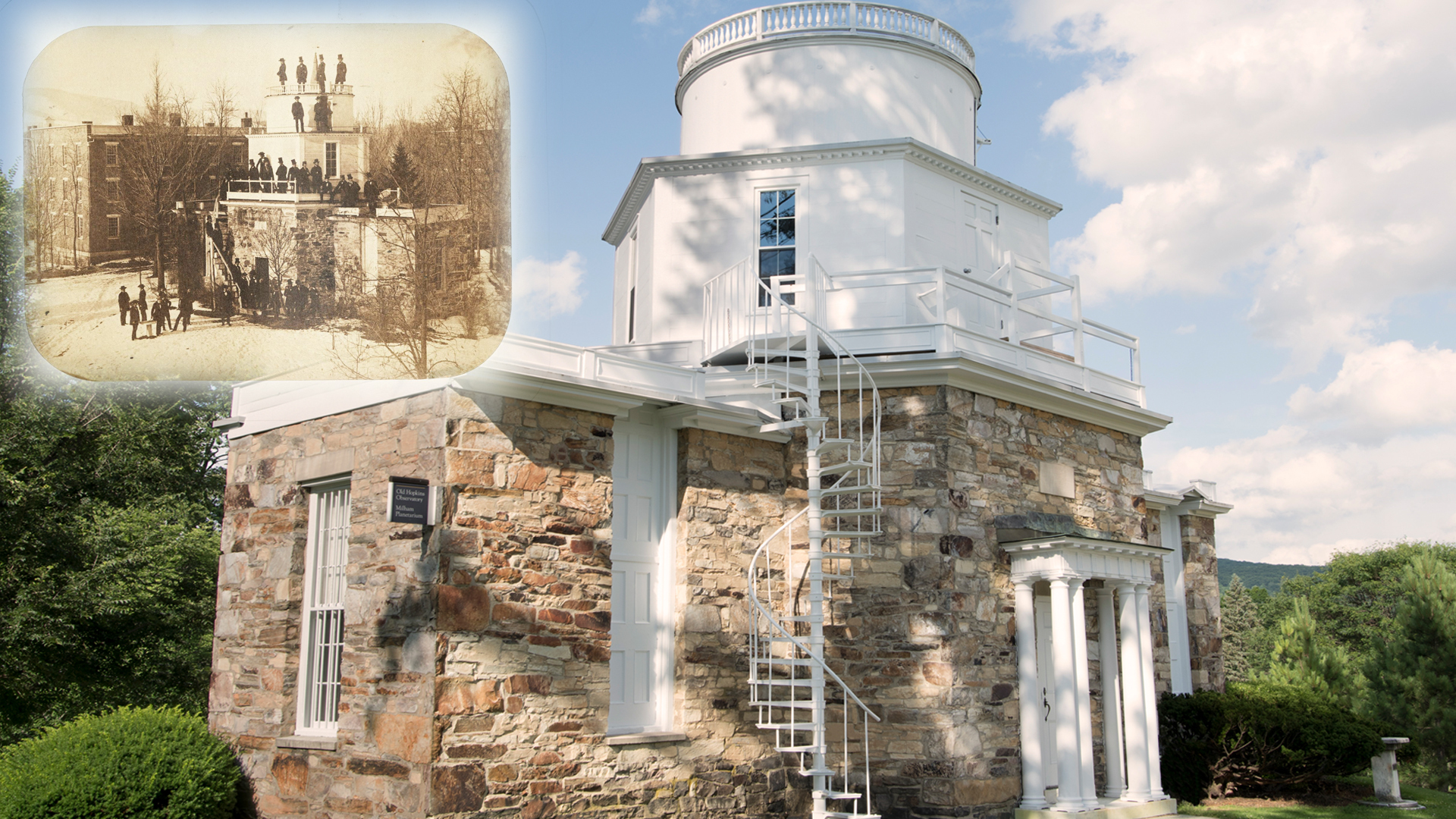
The 1800s were a boom time for observatories: 294 were established in the United States, and this may “represent perhaps only two-thirds of 19th-century U.S. observatories,” according to research in the Spring 2025 issue of the Journal of the Antique Telescope Society. Some historians refer to the period of 1875–1900 as the American observatory movement.
“There were a lot of observatories at colleges and universities under construction, and for affluent benefactors, contributing an observatory to an institution was a respectable and admirable thing to do,” says John W. Briggs, board secretary of the Alliance of Historic Observatories.
A revolution in instrumentation helped spur the boom, Briggs adds, as American-made telescopes increased in availability and quality. High elevations and clear skies led to numerous observatories in the American West, including Lick Observatory on Mount Hamilton east of San Jose, California, dedicated in 1888 and owned and operated by the University of California, and the Mount Wilson Observatory near Pasadena, founded in 1904.
Decades later, the moon landing spurred new construction of observatories. The Massachusetts Institute of Technology (MIT) opened one in 1971, when the number of MIT astronomy students “went from something like four to two hundred in a single semester,” says Michael Person, director of the George R. Wallace Jr. Astrophysical Observatory. Some of those Space Race–era observatories, however, are showing their age.
“Many of the telescopes funded in the 1960s and 1970s are now considered somewhat obsolete compared to modern ones,” Briggs says. Modern telescopes operate like industrial robots, he explains, with elaborate software for pointing and controlling instruments. Some operate fully autonomously. Older telescopes can be retrofitted with modern control systems, though it’s usually more efficient (if more expensive) to replace the telescope.
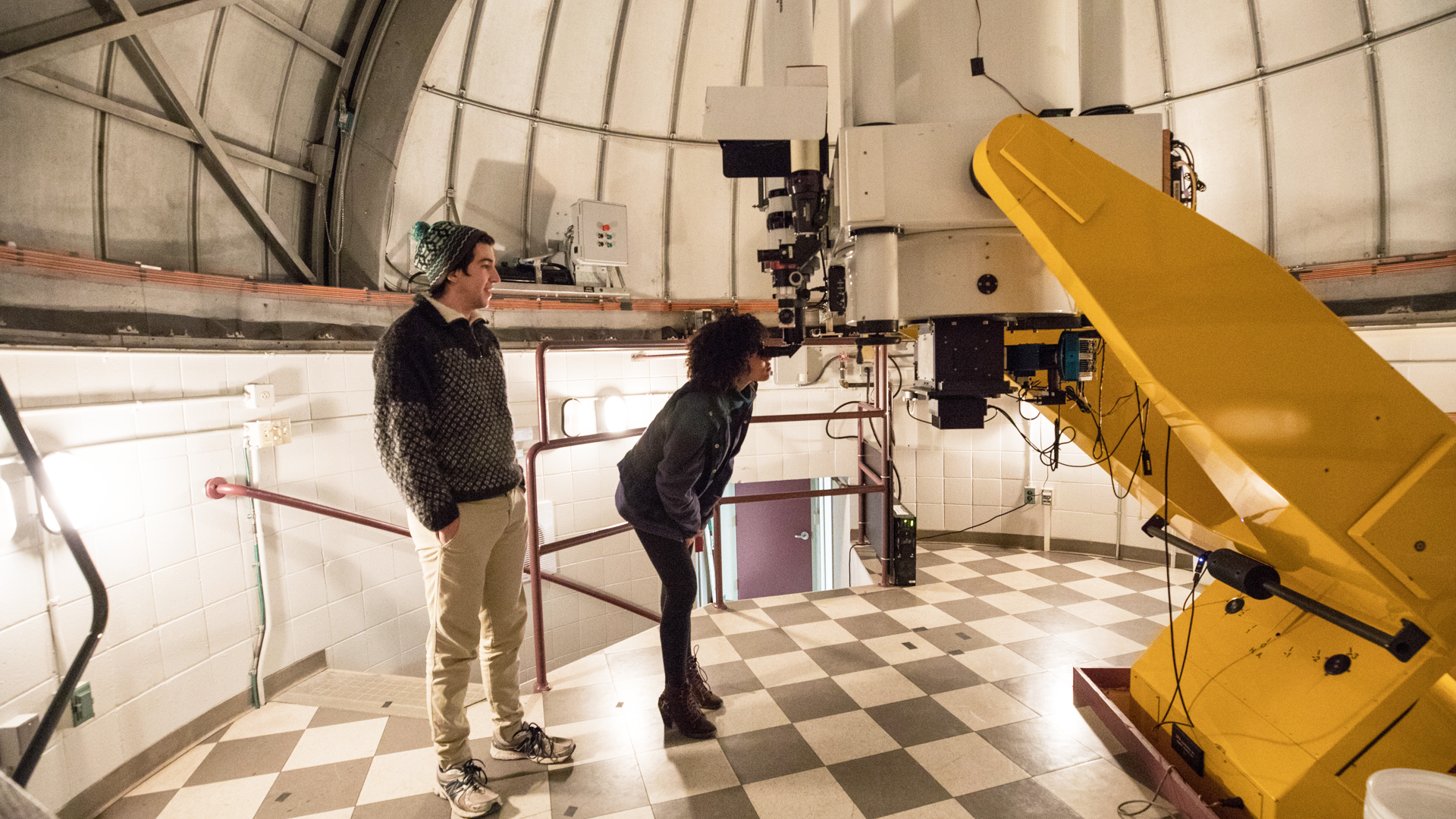
“Old telescopes, pointed by hand, can work for a century and remain very important educationally,” Briggs says. “They continue to do important and useful research, but for institutions that want to be at the cutting edge of observational cosmology, you need gargantuan telescopes, like what’s being built now on the mountaintops of Chile or at the summit of Mauna Kea in Hawaii.”
2 Smaller telescopes still play a vital scientific role.
Universities manage some of those gargantuan telescopes, as Briggs calls them. The McDonald Observatory in West Texas features three telescopes among those it operates, including the 153-ton Hobby-Eberly Telescope (HET), one of the world’s largest optical telescopes. Designed for spectroscopy—the decoding of light from stars and galaxies—HET is a joint project of the University of Texas at Austin, Pennsylvania State University, and two German universities, Ludwig-Maximilians-Universität München and Georg-August-Universität Göttingen. The Keck Observatory in Hawaii has two three hundred–ton telescopes; it is governed by the California Association for Research in Astronomy, which includes representatives from the California Institute of Technology and the University of California.
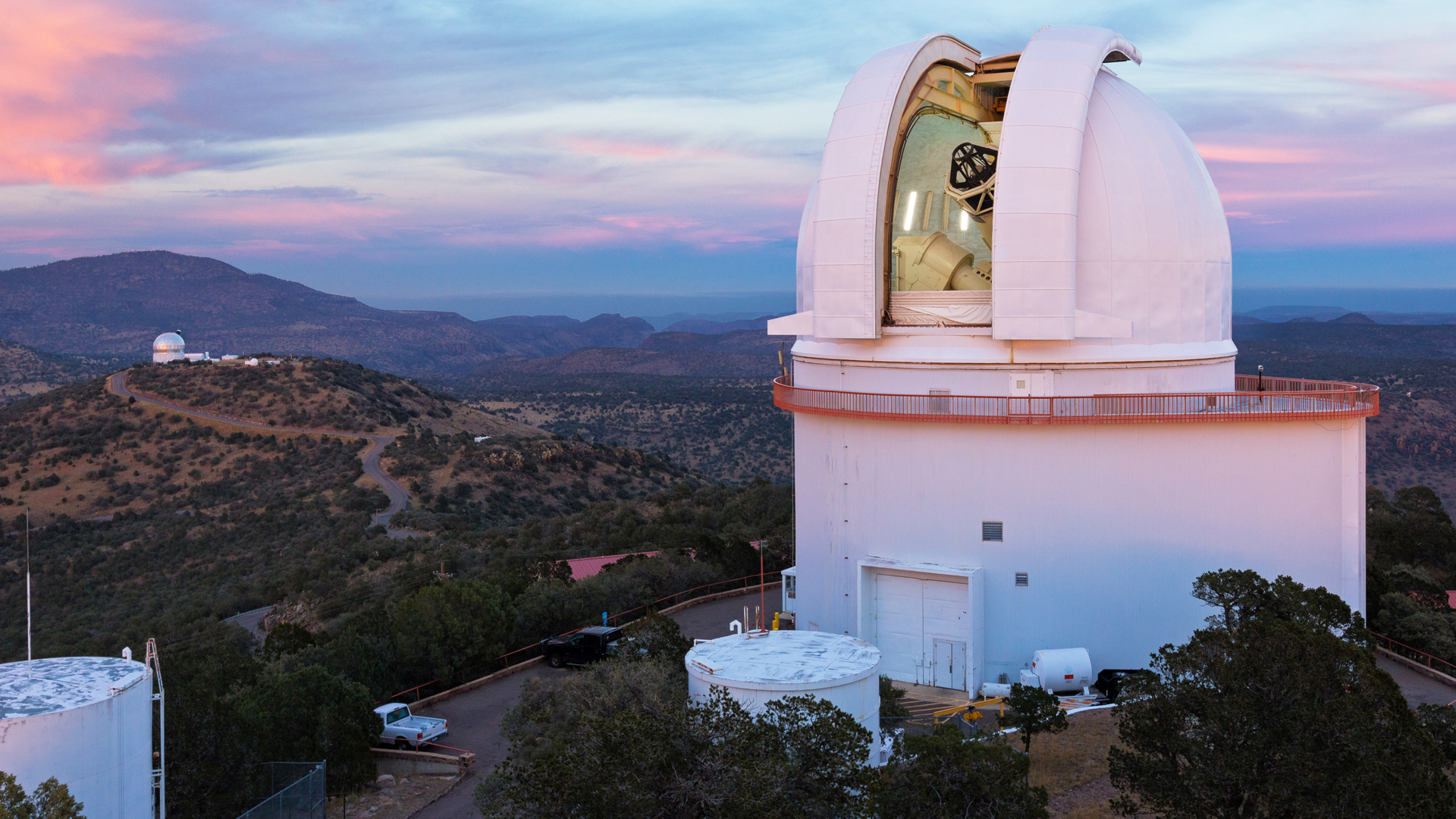
The University of Arizona’s Steward Observatory and Astronomy Department operates telescopes not only on four in-state mountains but also helps operate telescopes in Chile, the South Pole, and in space. UA’s Mirror Lab is also developing mirrors for the Giant Magellan Telescope (GMT), which is being built in a remote part of Chile. Led by a consortium of universities and research institutions in seven countries (including UA and seven other universities in the United States), the GMT will be up to two hundred times more powerful than today’s best earth-bound telescopes, and it will offer significantly better resolution than the space-based Hubble and James Webb Space telescopes. That may lead to discoveries of exoplanets (worlds that orbit other stars) that support life and to new understandings of dark energy and dark matter.
“The area I find most exciting at the moment are the characterization of exoplanets,” Jannuzi says. “We have samples of thousands of planets now. Forty years ago, we had just the planets in our solar system. The next generation of giant telescopes is going to help us in the search for signs of life on these planets, and they’re going to enable studying cosmology with an unprecedented accuracy, which will allow us to test whether there’s any new physics that we don’t know about yet.”
Big is often better when it comes to telescopes, but small telescopes are still doing important work. UA’s Catalina Sky Survey, for example, uses small telescopes to find near-Earth objects. At MIT, students are identifying exoplanets and measuring the shapes and sizes of asteroids, among other projects.
“There’s a lot of science you can do with more modest telescopes if you have the time, and we specialize in these sorts of long-term surveys,” Person says. “If you want to map out the light curves of every asteroid in the Koronis family in the main belt, that takes years. Each one takes several nights, so you spend a week looking at a single asteroid. You can do that in a university observatory, where different students come in to look at a different asteroid, and by the end of five or six years, you have a catalog of asteroids that you didn’t have before.”
Smaller observatories also serve a crucial educational role. At Williams College, the historic Hopkins Observatory now serves as a planetarium and museum, but the college’s “newer” sixty-year-old observatory has a telescope that was installed in 1991.
“We mainly use it as a teaching tool,” says Kevin Flaherty, supervisor of the observatory and an astronomy lecturer at the college. “A lot of astronomy is moving in a direction where it’s remote observing: You sit in your office and you operate remotely, or maybe you send in your request to target, and the folks running the observatory do all those for you and send you back the data. So, even for students who are interested in continuing astronomy, this might be the last time they’re actually sitting at a telescope, operating it themselves.”
That hands-on experience is valuable for budding astronomers, Jannuzi says.
“We’re able to put really good instruments on some of these small telescopes, so the students can learn the electronics and the software and all the other skills that you need to eventually use other more capable facilities,” he says.
3 Discoveries aren’t made alone.
Most of us associate major discoveries with individual geniuses. Galileo. Copernicus. Einstein. Hubble. But important research often relies on coordination among observatories.
“We do an awful lot of things by partnering with people,” Jannuzi says. Case in point: In 2017, astronomers produced the first-ever image of a black hole. Located in Messier 87, a galaxy about fifty-five million light-years from Earth, the black hole resembled a fiery doughnut. The images made headlines worldwide when they were released in 2019.
A global network of radio telescopes called the Event Horizon Telescope produced the shot. Instead of collecting visible light, like an optical telescope, a radio telescope collects radio light waves from black holes, galaxies, stars, and other astronomical entities. The collaboration involves more than two hundred researchers from five continents; the thirteen stakeholder institutes include UA and the University of Chicago. To obtain the image, eight radio telescopes pointed in the same spot in the sky at the same time, resulting in a composite set of images.
George Mason is also participating in a multi-observatory project. Mason is the home of NASA’s upcoming Landolt project, which will put an artificial “star” (a satellite) in orbit around the Earth. Scientists will use the star to calibrate telescopes and more accurately measure the brightness of nearby stars and even distant supernovas.
“We consider it the first modern hybrid space mission: In order to achieve its science objectives, it uses both a satellite in space and resources on the ground, meaning telescopes,” says Peter Plavchan, executive director of George Mason Observatories and an associate professor of physics and astronomy. “So, the satellite itself is effectively creating an artificial star in the sky, and it will drift among the stars as viewed from ground-based telescopes.”
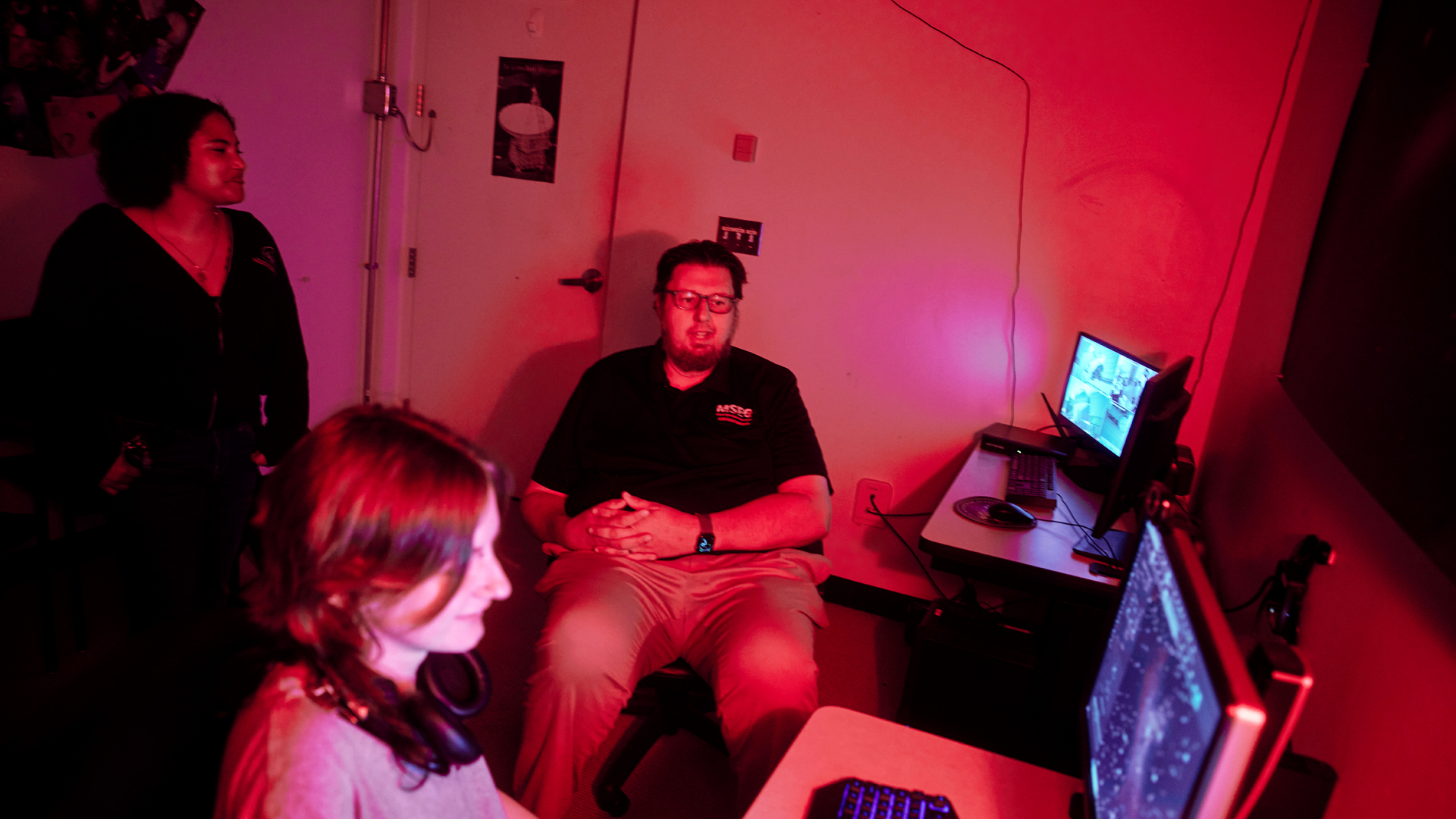
Mason will house the mission operations and science operations centers; build the software, electronics, and hardware for the payload; and assemble, integrate, and test the payload on campus. The university’s telescope will also serve as one of the ground stations. For Mason, taking a lead role in Landolt is a big deal, but when Plavchan talks about the project, he is quick to emphasize the other partners, including the California Institute of Technology, Mississippi State University, the University of Florida, the University of Hawai‘i, and the University of Minnesota, Duluth.
“We have observatories, plural,” he says.
4 Observatories build important skills and attributes in students.
Plavchan tells a story about a former graduate student. One night, the duo was installing an instrument at NASA’s Infrared Telescope Facility (IRTF) in Hawaii. “It’s fourteen thousand–foot elevation, and the oxygen deprivation gets to you,” he says. They made a mistake with the installation and when they returned to the control room, they heard a loud bang.
“The graduate student was like, ‘Oh, my God, my career is over,’” Plavchan recalls. “And of course, the telescope was fine. These are pretty robust telescopes. Today he’s a professor at the University of Hawai‘i. Someday he’ll be in charge of that telescope. I tell my students, it’s OK to break things. At Mason, this is a student telescope. And I’ve been impressed by how much the students take ownership—they know it’s their telescope.”
Such ownership helps students to grow. Before graduating from Wellesley College in 2025 with a bachelor’s in astrophysics, Treya Pember helped lead the astronomy club at the women’s liberal arts college in Massachusetts. She also tutored students at the observatory and worked on research there. Those experiences improved her problem-solving skills.
“The observatory is really open to being student-run,” she says. “The telescopes are all student-run. Our research is in the hands of students once the professors leave early in the day. So that leaves a lot of problem solving and troubleshooting in student hands. That develops the ability to think quickly on your feet and adapt and be able to tackle complex technical problems.”
Even for non-astronomy majors, the observatory helps develop important skills. In one astronomy course at Wellesley, students learn observational techniques using telescopes, they plan and execute observations, and they analyze and evaluate data, all of which improves their critical thinking abilities.
“I think of an observatory and astronomy curriculum as being core to the liberal arts experience,” says Jonathan Kemp, observatory manager and instrument specialist at Wellesley. “There are so many interdisciplinary threads you can pull on: physics, history, art, literature, Indigenous cultures, early civilizations, environmental studies, planetary geology, astrochemistry, astrobiology, computer science, data science, math, philosophy. All of those have a place to overlap with the observatory and with what we do here in astronomy.”
He sees that value, he says, when alumni come back to the observatory.
“They think of it as a special place,” he says. “They learned about community. They learned about observing the natural world. When you speak about a liberal arts curriculum, the common thread is intellectual curiosity, and an observatory is a critical element of that curriculum.”
5 Stargazing invokes awe—and we need that.
In 2024, an MIT student who had grown up outside of New York City arrived for the first time at the university’s Wallace Observatory, about forty miles northwest of the Boston campus. She saw more stars that night than she had seen in her entire life. In 2025, Person, the director of the observatory, brought her on an annual ten-day MIT trip to an observatory in Tenerife, the largest of Spain’s Canary Islands, where she saw the Milky Way for the first time.
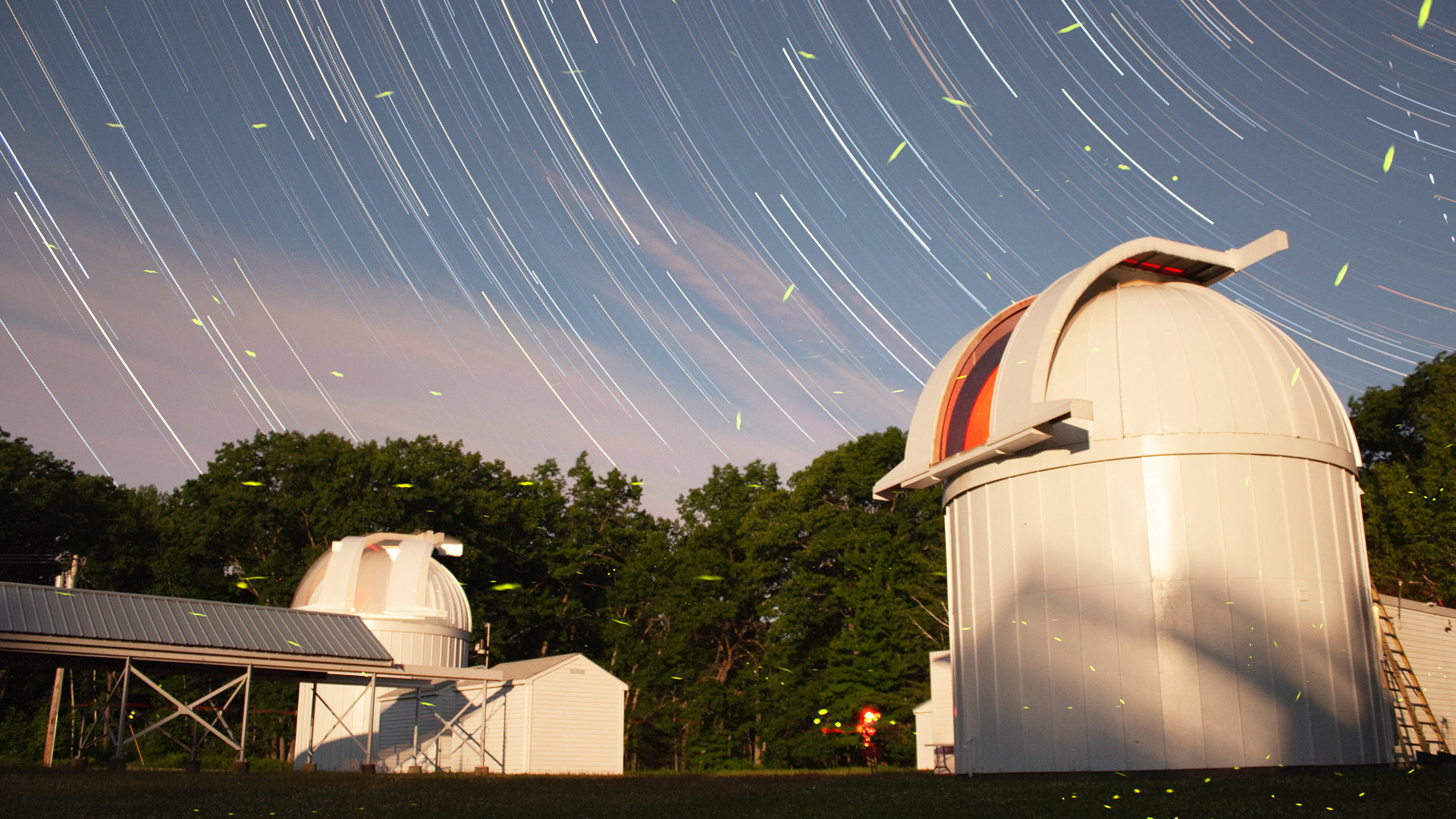
“She fell in love with the sky,” Person says of the student, who is now applying to graduate school in observational astronomy. “It was a full, spiritual transformation.”
Observatories can spark those transformations in all of us—students, children, alumni, local residents, retirees, or anyone who joins a tour. Telescopes are portals not simply for science but for joy.
“There’s still nothing more inspiring in astronomy than seeing Saturn for the first time through a telescope,” Jannuzi says. Whitefield, one of the Mason student guides, admits she cried the first time she saw Saturn. Person has seen similar reactions from people observing the moon: “You see the craters and you see the mountains, and you can see that it’s a real place. It becomes much less abstract. Looking through the telescope provides a connection you don’t get by just consuming media.”
Singh, one of my Mason guides, explains that connection on an intimate level. As we talk in the observatory, she notes that the sunlight reflected off a planet or the light from a distant galaxy or star—light that has traveled hundreds of millions of miles—goes inside of our retinas.
“In a way,” she says, “since the photons are going in your eye, you’re touching it.”
When she says that, I feel . . . awe. Awe for this moment, awe for these two bright students, awe for our bonds to the universe. We could all use a little awe right now, so absorb it as you would the light from the sun. And go tour an observatory. As Emerson wrote after his visit to Williams College, “Of all tools, an observatory is the most sublime. . . . The sublime attaches to the door and to the first stair you ascend, that this is the road to the stars.”
The Problem of Light Pollution
The Wallace Observatory at the Massachusetts Institute of Technology (MIT) was built in Westford, about forty miles from campus, to avoid Boston’s bright lights. But due to the region’s growth, local light pollution has increased by roughly 5 percent annually over the past decade. “It’s unsustainable,” says Michael Person, the observatory’s director.
Many astronomers cite bright skies as their biggest challenge. In a study published in 2023 in Science, light pollution (from sources such as buildings, vehicles, billboards, and streetlights) increased by as much as 10 percent per year over a twelve-year period. At that rate, in an area where 250 stars were visible in the night sky in 2023, only 100 will be visible in 2041, noted lead author Christopher Kyba, then a researcher at the German Research Centre for Geosciences.
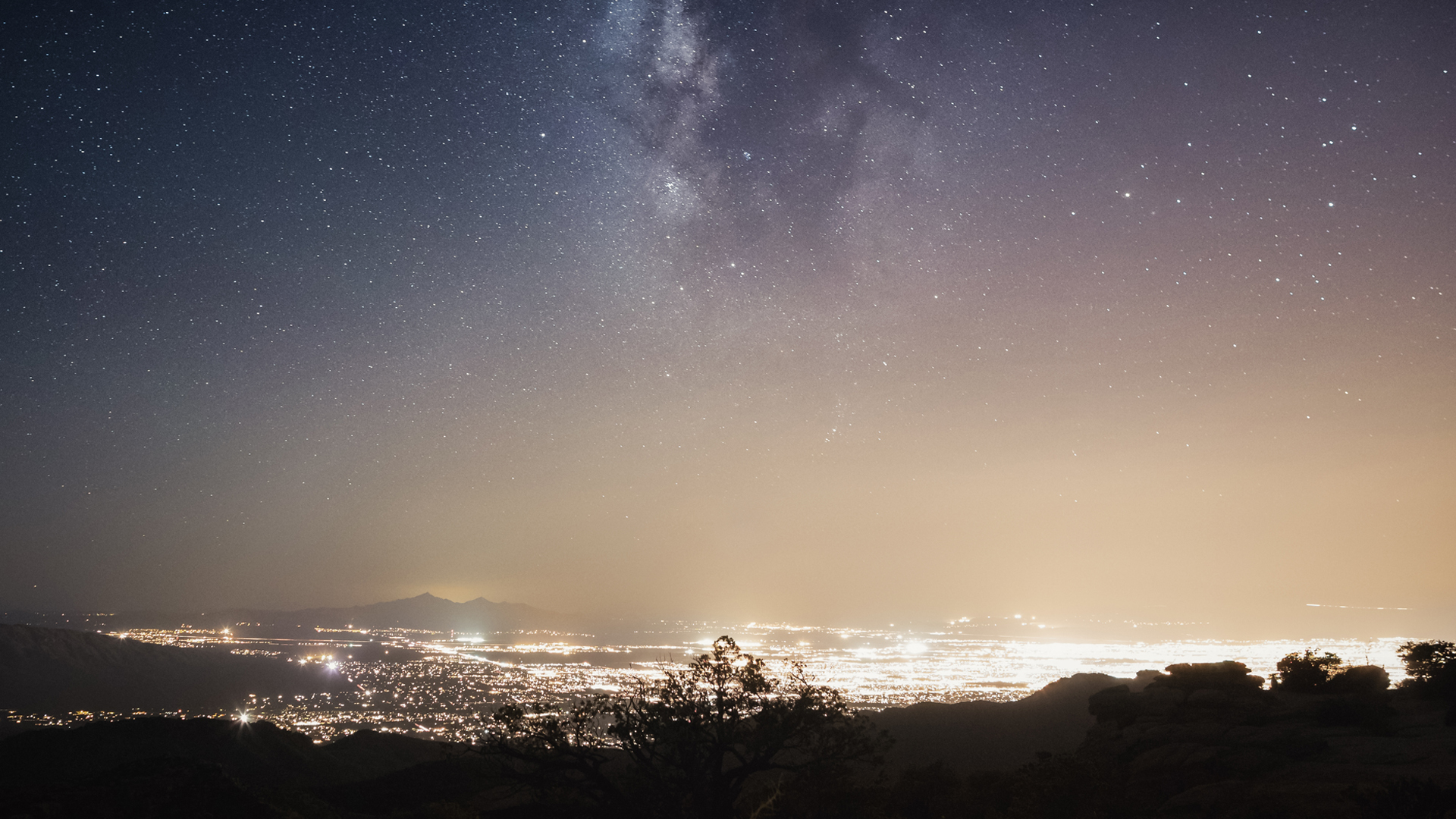
Among the reasons for the increase: LED lighting. LEDs are more energy efficient than traditional bulbs, but they are brighter and emit more glare. In 2018, the Chelan County, Washington, government began retrofitting almost 3,700 high-pressure sodium streetlamps to LEDs, and by the following year, 51 percent of the stars were no longer visible to the naked eye—even though the light was directed toward the ground, a 2021 study in the Journal of Environmental Management found. By 2035, 84 percent of lighting installations will use LEDs, according to the US Department of Energy.
Another issue: the common perception among everyone from homeowners to business owners that more light equals better security. To combat that, observatory staffs often lobby decision-makers both on and off campus.
“We work with the local town councils and zoning planning commissions to try and keep reasonable limits on light pollution,” Person says. “We also include the students in that. Students have gone to select board meetings. I’ve had undergraduates testify at the state house to the committee on technology and work on statewide legislation to combat light pollution. We’re not against light,” he emphasizes. “We’re against useless light that’s poured into the sky.”
To learn more about how your campus can help darken the night sky without reducing security, go to CampusShine.org.
Astronomy Clubs: A Stellar Experience
When a solar eclipse darkened parts of North America on April 8, 2024, the University of Wisconsin–Madison astronomy club was ready. The club hosted an on-campus viewing party that attracted thousands of students and community members, and club members distributed more than one thousand viewing glasses.
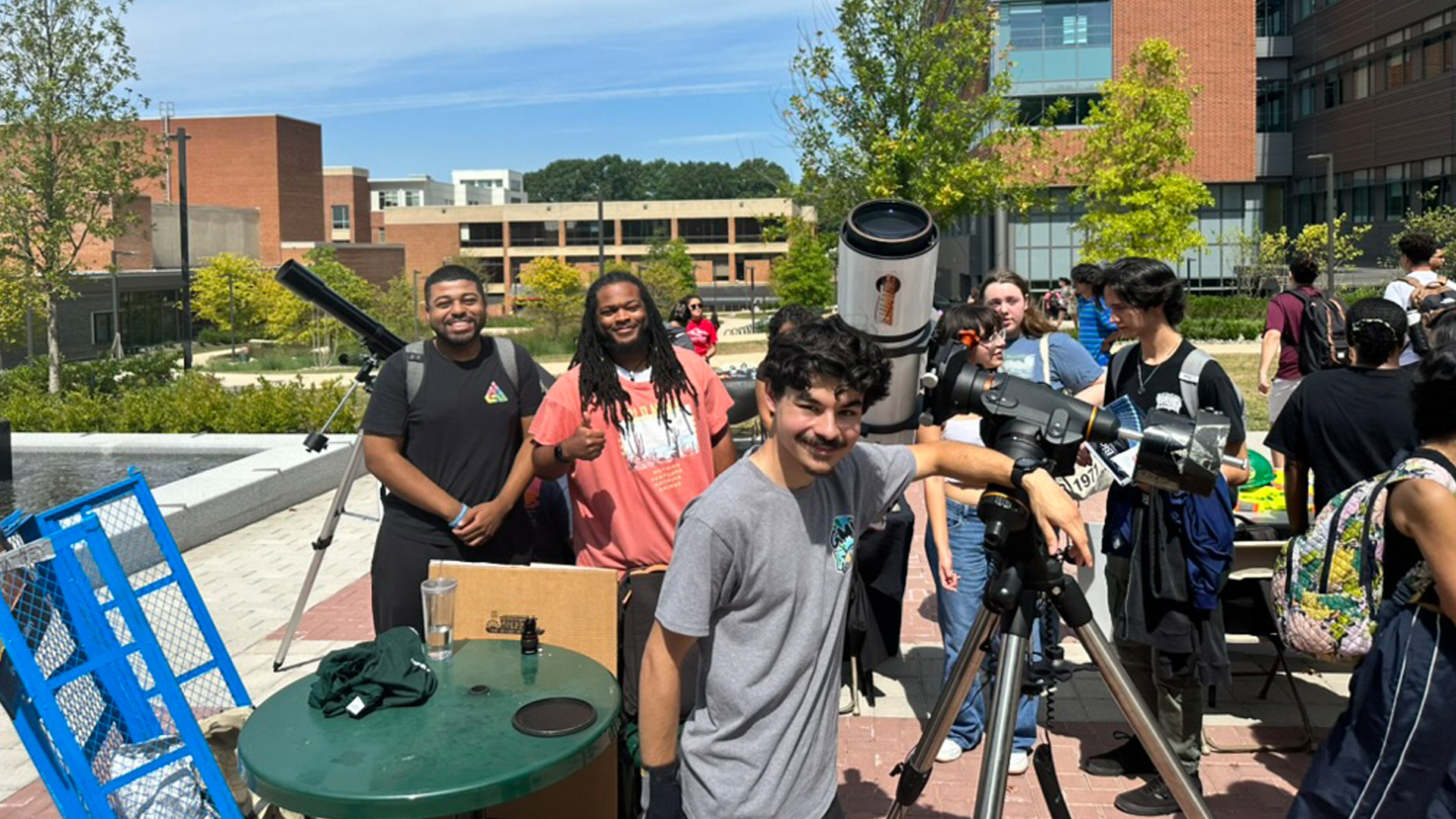
Astronomy clubs play an important social and educational role. Club members often lead observatory tours. At the Georgia Institute of Technology, club activities range from stargazing camping trips to movies to planetarium visits. Non-astronomy majors are welcome. In Maine, a co-president of the Bates College astronomy club, Evan Boxer-Cook, is a classical and medieval studies major. Jonathan Kemp, observatory manager and instrument specialist at Wellesley College, has seen similar engagement.
“We have an awesome astronomy club, and our presidents right now happen to be non-majors in astronomy and physics,” Kemp says. “I think that proves the allure and the interest and the accessibility of the observatory as a key element of a liberal arts experience.”
The Power of Public Tours
If you think public tours are an astronomical annoyance for busy observatory directors, guess again. Most observatory leaders see tours as an opportunity to share knowledge and connect with the public.
“Astronomy is one of our gateway drugs to science,” says Buell T. Jannuzi, director of the Steward Observatory and head of the Department of Astronomy at the University of Arizona. Those cosmic views can inspire not only children but undergrads. As an undergraduate student at McMaster University in the early 2000s, Danny Milisavljevic worked on an astronomy project that identified four new moons orbiting Uranus. The work, however, was tedious. Each day, he reviewed thousands of images. Then, as a grad student at Dartmouth College, he visited an observatory, which truly ignited his passion for astronomy.
“It reminded me of the first time I looked through a microscope, where I’d prepared a slide of bees’ wings, and I could look and see all this detail that I’d never noticed before,” Milisavljevic, now the operator of Purdue University’s Astro-Boilermaker Telescope, told a Purdue reporter in 2022. The telescope, he said, “was like a microscope was in the sky. It was amazing, this rich detail in the universe that I couldn’t see otherwise.”
Such cosmic “wow” moments are common on public tours.
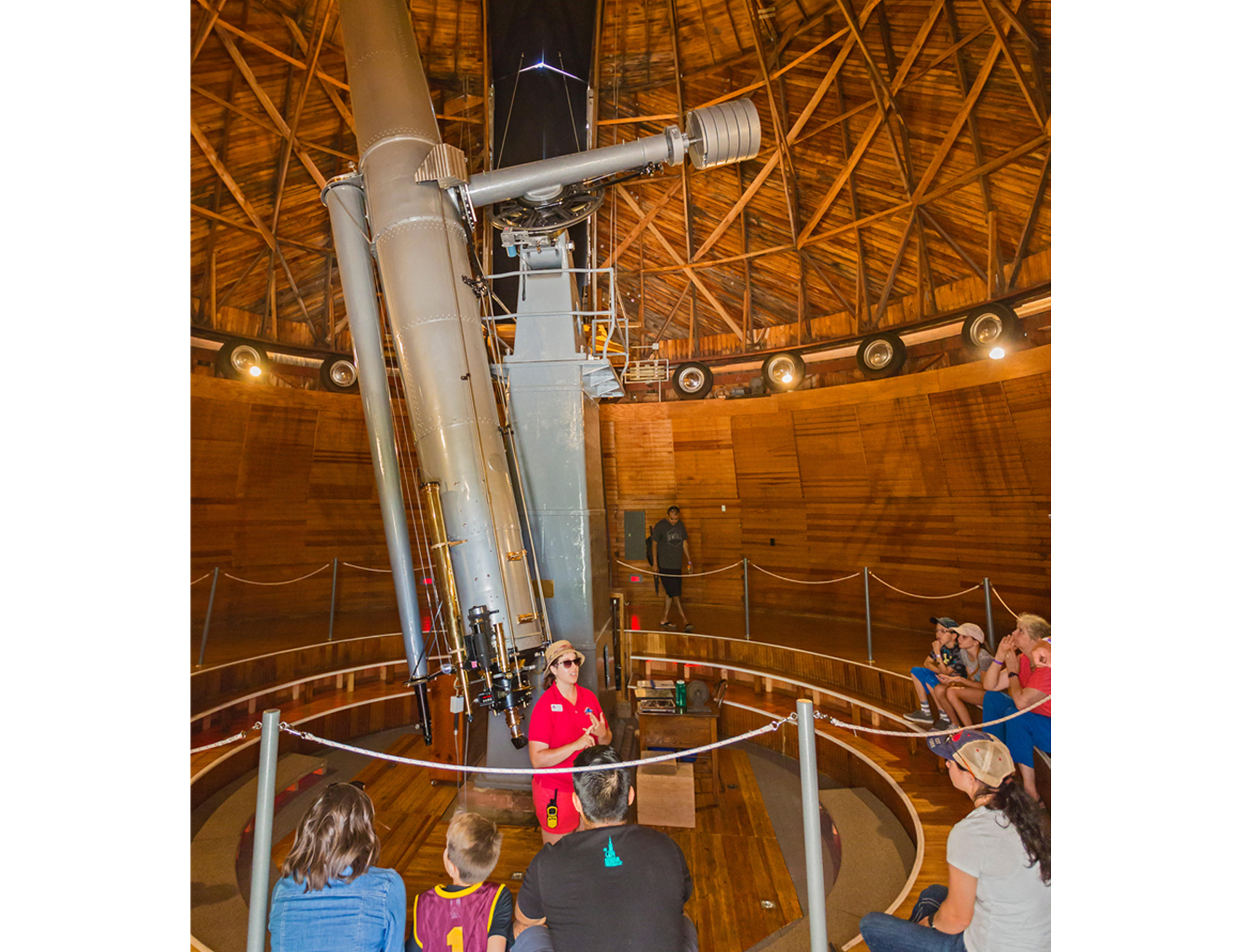
“There’s just a ton of enthusiasm,” says Kevin Flaherty, supervisor of Williams College’s observatory. “People are excited about looking through a telescope and hearing about the extremes of the universe.”
For visitors, the tours can increase their connection to not only the stars but the university.
“We view tours as part of our mission,” says Peter Plavchan, executive director of George Mason Observatories. “We’re a state institution, we’re funded by state taxpayers, so we feel an obligation to make sure [the observatory] is accessible to our community.”
Lead photograph by Jared Soares
Exclusive Content