
Lost in Translation
Enrollments in foreign language courses are posting some of their biggest declines. But some universities are finding new ways to attract students.
⚠️ You have free article remaining.
Log in or become a member for unlimited access.
In a higher education landscape where career prospects are the top priority for most students, humanities degrees face a fundamental challenge.
“The major isn’t named the same name as a job,” says Thor Sawin, a professor and associate dean of Language Schools at Middlebury College.
Indeed, a French major can’t easily walk out of commencement and into a job as a Frenchist in the way that a science major can walk into a job as a scientist.
This is one reason enrollments in university-level foreign language courses are in a state of nationwide decline. While colleges and universities saw an 8 percent decline in the number of students overall between fall 2016 and fall 2020, language enrollments dropped 16.6 percent during the same period, the largest decline since 1958 when the Modern Language Association (MLA) began its enrollment census.
The 2021 census (the MLA’s most recent) surveyed enrollments in 258 languages from 2,455 institutions. During the study period, American Sign Language (ASL), Biblical Hebrew, and Korean were the only three of the fifteen most commonly taught languages that showed overall gains in enrollments, according to the census. European languages posted some of the biggest declines, with German dropping 33.6 percent. It’s also notable that two-year institutions lost more language students (with a 24.2 percent drop) than four-year institutions (which had a 14.7 percent decrease).
The census isn’t universally bad news—a little more than a third of language programs increased their number of students or remained stable, compared to about two-thirds that declined—but it does raise big questions for the survival of foreign language instruction at the college level.
“The humanities are in a defensive posture nationally in general these days,” says Paula Krebs, executive director of the MLA. Though the 2021 MLA data mostly describe a pre-pandemic state of affairs and doesn’t capture what has happened in the aftermath, experts in the field report that these trends and challenges remain.
Bill Rivers, who runs the language consulting and lobbying firm WP Rivers & Associates, attributes language enrollment declines to the overall loss of interest in the humanities and an increasing focus on job-friendly majors in STEM fields.
In a shocking (if unrepresentative) example, West Virginia University rocked academia in 2023 when it announced it would totally shutter its world languages department in the face of a budget shortfall. (It later decided to retain some language instruction and currently offers minors in Arabic studies, Spanish, Chinese studies, and French).
But there are notable exceptions to the overall decline. Indeed, at institutions all over the country, faculty and administrators are innovating new ways to attract students into language majors, whether by proposing dual-degrees with career-focused fields or amping up marketing approaches that emphasize that humanities degrees do, indeed, lead to prosperous careers. In many places, the efforts are working: These programs are managing not only to hold participation rates steady but in some cases are creating big boosts in language enrollments. And many of the students in those programs are going on to find successful careers that might not so obviously flow from a degree in a foreign language.
“If you study French, it’s not to prepare you to be a Frenchist when you graduate,” Krebs says. “It’s to prepare you for a whole range of possible careers, and it’s seen as part of a larger . . . liberal education that’s necessary for career preparation.”
Indeed, while language on its own has plenty of value for a range of careers, emphasizing real-world applications appears key to growing language enrollments in this era. Pairing language with career-oriented programs has shown success at more than a few institutions.
At the University of Rhode Island (URI), this is now the main driver of language enrollments. “What has really worked well for us is what I would call integrated dual-degree programs,” says Lars Erickson, a professor of French at URI.
Erickson is also the director of the French International Engineering Program. The IEP, as it’s known, was the university’s first foray into the dual-degree language approach. It’s a five-year commitment that gives students the opportunity to earn a bachelor’s in engineering as well as a bachelor’s in the language of their choice (Chinese, French, German, Japanese, Italian, or Spanish).
The cornerstone of the program is a full year spent abroad, half in the classroom and half at an internship related to engineering, an experience that is almost universally loved by students, according to Erickson.
The success of the language-and-engineering pairing has inspired several copycats at URI, including programs in international studies and diplomacy, international business, and international computer science—all structured as five-year dual-degrees with a year spent abroad.
These innovations have helped pull URI out of the national trend of declining language majors: It saw about a 4 percent increase in language majors in 2025. “We’re happy with that. We’re feeling optimistic about that,” he says.

Students appear to be quite happy about it, too. Stefanie Vining is a recent graduate of URI’s international engineering program and an example of what it can help students accomplish.
Vining was attracted to URI specifically because of the dual-degree option, which allowed her to pursue a familial connection to the French language as well as an interest in chemical engineering—a combination that might not have been possible elsewhere.
The year abroad was the defining experience for Vining. “The internship is what really propelled my French,” she says, because it forced an immersion with French-speaking colleagues, taking her language learning a step beyond classroom instruction.
It had another benefit: After her internship at Unither Pharmaceuticals, the company offered her a job. Vining had chosen to do the year abroad in her final year at URI, so after completing the program in August, she returned stateside for a couple of months to visit family and then went back to France as a full-time employee of Unither.
Her French proficiency allows her to work for a French firm, but her English fluency is also an asset for the international business. “It is a very useful tool to have, and many, many people will value it,” she says.
The utility of language proficiency in the business world has inspired a similar innovation at Montclair State University in New Jersey.
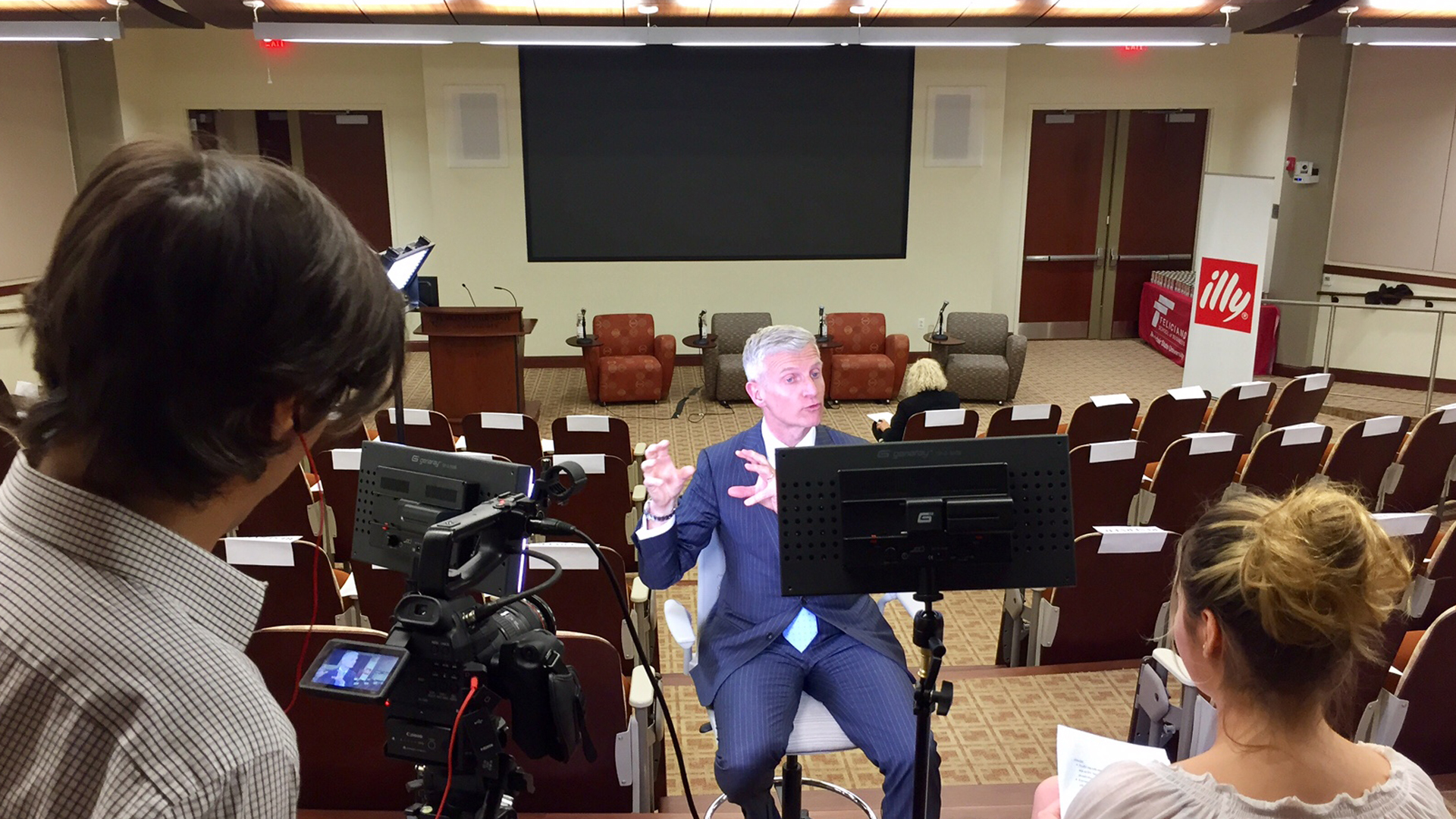
Enza Antenos, an associate professor of Italian, led the creation of the university’s bachelor’s degree in language, business, and culture—a partnership between the College of Humanities and Social Sciences and the Feliciano School of Business.
Rather than offering students a dual-degree, Montclair’s approach is a single, integrated degree: the university’s first cross-unit major. “Language was not just going to be an add-on to business classes. There is an integration of the courses,” Antenos says. She adds: “We have these two different units, but we’re pulling together in the same direction.”
The degree was established in 2019 and allows students to focus on one of seven languages alongside their business studies. Antenos says enrollments have been promising: After an initial burst of interest, the numbers have been steady. She estimates that, within the first three years, the program saw a hundred majors.
Recently, Antenos has introduced a new “gateway course,” an introduction to intercultural business communication, that could help get students on the path to the major. The course is co-taught by Antenos and a management professor. “We talk about the same topics but from diverse perspectives,” she says.
Antenos has also helped create Montclair’s Career Hub for International Language Learning, a resource center for multilingual students and those interested in exploring how language can help their career prospects.
These types of programs are showing promise, but Antenos says creating them can entail certain challenges.
“It takes a very united and collaborative team to build success for the program,” Antenos says. “You need administrators who are going to believe in the end product.”
Strong administrative support helped the University of Arizona embrace a somewhat contrarian approach to growing language enrollments.
Alain-Philippe Durand, who arrived on campus in 2016 as the university’s Dorrance Dean of the College of Humanities, is leading the charge with an unabashed campaign that “Humanities = Jobs.”
The program’s marketing materials emphasize not only language proficiency that students receive from a language major but also the skills that can lead to lucrative corporate careers.
“When you major in a language, you’re also going to be able to think critically,” Durand says. You also get practice in intercultural competence, collaboration, creativity, and problem solving. And as Durand puts it: Every company wants those skills.
But he knows it’s not enough for him, as the dean, to say those things. The college has invested heavily in marketing materials that foreground alumni voices and success stories. In one promotional video, a parade of Arizona language graduates tout how their degrees helped them succeed in jobs at the likes of Netflix, Blue Apron, and the US Department of State. “That goes a long way,” Durand says of the testimonials.
He’s also trying to build a “culture of recruitment” at the college. The idea stemmed from when he was hiring language professors earlier in his tenure as dean. Durand asked candidates how they’d convince more students to declare language majors—basically, how they would recruit. Many didn’t have an answer, which inspired Durand to hire a director of recruitment, who now works to recruit students directly and also runs a two-day recruitment workshop that is required for incoming graduate teaching assistants and open to all faculty.
Recent enrollment data from the university appear to support this approach. French majors have seen the most substantial growth, with a 26 percent enrollment increase from fall 2023 to fall 2025. During the same period, Italian majors grew by 21 percent, and German majors increased by 20 percent.
Language minors are also seeing a boost. According to Durand, the Spanish minor continues to be the largest undergraduate minor on campus, while the Italian minor increased 108 percent from spring 2022 to spring 2025.
Again, Durand emphasizes the importance of supportive administrators who see the value in humanities. “You cannot do anything if you do not have the support of your administration,” he says.
Beyond buoying language majors, Durand has also pioneered a degree in “applied humanities.” The program is a partnership between eight (out of twenty) colleges on campus that allows students to combine traditional humanities courses with a career-focused emphasis like business administration, environmental systems, or public health. (Students can also take electives in foreign languages, though they are not a major focus of the applied humanities degree.)
Durand said the idea came from his own experience as an undergraduate creating a triple-major to pursue his disparate interests in business, French, and Spanish. As he sees it, whatever a student is interested in, “we need to have an answer to that.”
American students need not go abroad to realize the utility of their foreign language skills.
In the United States, American Sign Language interpreters are in high demand, according to Brian Cheslik, an assistant professor at the University of Texas Rio Grande Valley (UTRGV), who is deaf.
“Deaf people are everywhere,” says Cheslik, making ASL interpreting a human services profession with strong job prospects.
UTRGV had offered ASL courses for many years, and saw its enrollments grow from more than 400 in fall 2016 to more than 650 in fall 2021, according to the MLA.
In 2020, Cheslik helped launch the college’s American Sign Language and Interpretation bachelor’s degree. During COVID, enrollments in ASL courses remained especially strong because they were offered online and asynchronously, Cheslik says.
The program has since shifted back to traditional face-to-face class options, or online synchronous options, that Cheslik says are more effective for students. “This has caused a decline in enrollment for our ASL classes, which we hope is just a transitional period,” he says.
Cheslik credits the success of the program so far to the fact that the curriculum is designed and facilitated by deaf professionals. “The language has many cultural aspects that are ingrained in the language that a hearing, nonnative signer can never fully grasp or understand,” he says. “This is why the deaf community is constantly advocating that people learn ASL from a deaf person.”
ASL skills are not only useful for aspiring interpreters, he points out, but also for other kinds of careers. “Learning ASL can benefit people in every field because it makes you accessible to a large population of potential clients who prefer to have direct communication with our service providers,” he says. “When I find a barber or a car mechanic who knows ASL and can communicate with me directly, I give them my business, and I share their business with my community.”
American students can also find a worthwhile academic path in the field of Indigenous languages, of which there are more than seventy spoken in the United States.
Here, the motivation might be less career centered and more tied to the urgent need for preservation, as many of these Indigenous languages are at risk of disappearing in the next decades.
“If you lose the language, then you lose a particular appreciation for how to take care of the land around you, as well as a sense of yourself,” says Elizabeth Sumida Huaman, a professor and chair of the Department of American Indian Studies at the University of Minnesota (UMN). “How do we start to think about Indigenous languages as not necessarily dead [but rather] as having the possibility of being reclaimed?”
This question guides Sumida Huaman’s work at UMN, which she says is the premier institution globally for training Dakota and Ojibwe speakers. She counts about twenty-five majors across the two languages. “It’s less about quantity—it’s more about quality,” she says. “The significance goes beyond the numbers.”
Indeed, these languages contain within them entire worldviews that otherwise be lost without a new generation of speakers. “Every speaker that is produced is combating centuries of assimilation and erasure,” Sumida Huaman says.
The future of such Indigenous language programs, however, is somewhat fragile. Sumida Huaman says these departments must avoid relying solely on types of funding, like federal grants, that are subject to “whims and threats.” The future she sees, instead, is one that depends on internal community goodwill, with Indigenous communities helping each other.
The bright spots notwithstanding, the foreign language field is still facing considerable challenges at this moment, not least of which are the policy changes at the US Department of Education.
In the fall of 2025, the department announced it was cutting Title VI funding that supported some foreign language instruction at universities. The funding was originally established in 1958 as part of a trend that saw language study as important for business and defense.
The Trump administration, however, has taken a different tack. “It’s part of an isolationist push,” Krebs says. “That’s not going to serve us well.”
Deborah Cohn, a professor of Spanish and Portuguese at Indiana University, says the loss of federal support is especially problematic for the study of less common languages that depend on Title VI funding. “Devastating is a good word for it,” she says.
Artificial intelligence serves as another potential threat to language learning: When translation is quick, easy, and ubiquitous with AI tools, students may see less of a need to put in the hard work of learning a foreign language the old-fashioned way.
But, of course, learning a language is not just memorizing conjugations or translating text. “A language class is the perfect place to learn” the skills AI can’t replicate, like empathy, active listening, creative thinking, global awareness, and analytical thinking, says Middlebury’s Sawin.
As he sees it, this era of falling language enrollments and political pressures can actually serve as an opportunity to redesign curricula to emphasize not only language proficiency but the larger benefits and career applications of a language education.
Indeed, many of the most successful language programs have done just that. They’re not staying isolated in the language department; they’re linking up with business or science programs and proving to students that language education has plenty of value for a range of careers.
Illustrations by Paul Spella
Exclusive Content