Pre-Conference Workshops
Pre-conference Workshop Fee:
- $275 (Members)
- $350 (Nonmembers)
Morning Workshops
8:00–11:00 a.m. ET
Workshop 1
Interdisciplinary AI: A Principled Guide to Collaborative Teaching and Learning Initiatives
This interactive workshop introduces three principles for guiding interdisciplinary collaboration in AI-focused teaching and learning initiatives: (1) search for a higher love, (2) lend an ear, and (3) trade in trust. Participants will use these principles to reflect on what makes cross-disciplinary work challenging at their institution, analyze common strategies that undermine such collaboration, discuss why it is essential to AI-focused teaching and learning initiatives, develop listening strategies that strengthen partnerships among faculty and administrators, and imagine methods for sharing teaching and learning insights across the institution.
Participants are encouraged to bring institutional documents such as mission statements, academic integrity policies related to AI, sample curricula that develop AI literacy, descriptions of AI professional development initiatives, and a list of challenges related to interdisciplinary engagement. Participants will leave with a practical plan for leading AI-centered teaching and learning initiatives at their institution.

Kyle Jensen
Assistant Dean of AI and Emerging Digital Technologies, Arizona State University
Workshop 2
Academic Integrity in the Age of AI: Practical Strategies to Positively Influence Cheating and Student Learning
While many institutions are grappling with curricular reforms to support AI literacy, a recent AAC&U survey of faculty revealed that academic integrity and cheating continue to be the primary concerns of those in the classroom. With the emergence of agentic AI, academic integrity concerns have become even more complicated. While the challenges presented by AI in terms of academic integrity are thorny, there are practical, evidence-based steps faculty can take to decrease the probability students will choose to cheat in their courses. This workshop will present the options, including effective AI detection solutions, and provide a portfolio of strategies that can positively impact students’ behaviors regarding cheating.
In addition to exploring an array of strategies applicable across all disciplines, the workshop will feature hands-on activities in which participants will analyze sample assignments, use AI detection tools, explore AI tools from both student and instructor perspectives, and redesign course activities to align academic integrity goals with meaningful learning outcomes. Particular attention will be given to strategies that make cheating less attractive, learning more visible, and AI use more intentional and ethical.

Camilla Roberts
Director of the Honor and Integrity System, Kansas State University

C. Edward Watson
Vice President for Digital Innovation, AAC&U
Workshop 3
AI and the Future of Higher Education
Artificial intelligence is rapidly moving beyond chatbots into a new phase of agentic AI—systems capable of planning, reasoning, and taking actions on behalf of humans. As these technologies begin to write, research, analyze data, and make decisions, higher education faces a provocative question: If AI can perform many cognitive tasks once associated with expertise, what becomes the distinctive role of human thinking, learning, and institutional leadership? This interactive workshop invites faculty and staff to explore how agentic AI is reshaping knowledge production, teaching and learning, and the institutional operations that support research, education, and decision-making, while raising urgent questions about authorship, data governance, and the ethical boundaries of automation on campus.
Through collaborative activities and real-world scenarios, participants will examine how to keep humans meaningfully in the loop while integrating AI into learning, academic work, and institutional processes. The workshop will explore strategies for strengthening critical thinking and critical AI literacy while also engaging participants in conversations about policy development, governance, and responsible institutional transformation. Participants will leave with practical artifacts—discussion frameworks, classroom prompts, and policy conversation starters—that can help spark meaningful dialogue and guide thoughtful AI adoption across their campuses.
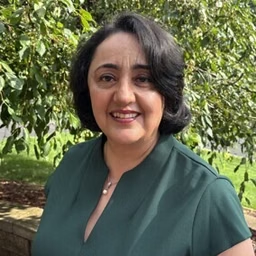
Mozhdeh Khodarahmi
Director of Libraries and Archives, College of Saint Benedict and Saint John's University

Bethany Miller
Associate Provost and Chief Data Officer, Macalester College
Workshop 4
Adapting to Innovation: A Framework for Strategic Agility in a Changing Landscape
How do institutions—and the individuals within them—move from reactive chaos to intentional, strategic innovation? This hands-on preconference workshop introduces the Adapting to Innovation Agility Framework, a structured yet flexible model designed to guide thoughtful implementation of emerging change across educational and organizational contexts. Rooted in change management theory and centered on students, faculty, and industry stakeholders, the framework begins with a comprehensive landscape analysis and is organized around three interconnected pillars: (1) governance, (2) operations and infrastructure, and (3) practice and pedagogy.
Participants will engage in interactive exercises that bring the framework to life from both individual and institutional lenses, making abstract concepts immediately applicable to their own contexts. Throughout, the workshop will explore how to stay grounded in lived experience as a foundation for leading tomorrow, drawing on what we know, what we’ve navigated, and who we are as practitioners and leaders. Participants will leave with a personalized roadmap for strategic, values-aligned implementation and, just as importantly, a renewed sense of confidence and agency to lead effectively beyond the chaos.

Michelle Singh
Vice President of Strategic Educational Alliances, University of North Texas
Afternoon Workshops
12:30–3:30 p.m. ET
Workshop 5
Calibrating Institutional Responses to Various AI Challenges to Stakeholders Who Disagree About AI
Leaders in higher education face difficult choices when developing an AI strategy. Some may seek to drive their institutions forward by mandating widespread adoption of AI tools, but such approaches can encounter significant faculty resistance. Importantly, this resistance does not necessarily stem from fear of the unknown or rejection of technology; in many cases, it reflects solid pedagogical reasoning. There are legitimate reasons to limit or discourage student use of AI in support of particular learning outcomes, courses, or disciplines. At the same time, other faculty are eager to maximize co-creation with AI or to integrate AI fluency into their teaching—approaches that may also be essential for preparing students for their future careers.
How can campus leaders navigate questions of policy, governance, and ethics when faculty perspectives are so divided? This workshop explores strategies for bridging these differences through guided dialogue, shared institutional experiences, and consideration of models where in which multiple approaches can coexist productively. Participants will leave with concrete, context-sensitive strategies for leading AI initiatives within their own institutions.

Kevin Yee
Special Assistant to the Provost for Artificial Intelligence, University of Central Florida
Workshop 6
Twice Disrupted: Understanding and Serving the Class of 2030
This interactive, hands-on workshop explores how institutions can assess and strengthen their readiness to serve a student cohort uniquely shaped by COVID-19 and generative AI. Participants will consider both the risks of under-preparation and the opportunities created by intentional, coordinated responses. Drawing on current insights into generational disruption and student development, the workshop examines the evolving landscape of student needs, including belonging, academic resilience and integrity, and digital fluency, with a focus on cross-functional strategies that support institutional retention and completion goals.
Participants will explore how campus roles—including faculty, advisors, student affairs professionals, and administrators—can be leveraged in alignment with shared institutional priorities to support student success and persistence. Through guided discussions and applied examples, participants will develop concrete, actionable strategies for building campus-wide readiness that strengthens student outcomes, enhances cross-functional collaboration, and responds to shifting enrollment realities.

Tameka Battle
Professor Health Sciences and Chief Academic Integrity Officer, The City University of New York, LaGuardia Community College

Susan Purrington
Harold F. Wiley Generative AI Teaching and Learning Fellow, Connecticut College
Workshop 7
AI and SoTL: Asking Good Questions for Solid Guidance
As generative AI tools rapidly permeate educational environments, educators face both a challenge and an opportunity: to understand how these technologies are shaping teaching and learning, and to respond in ways that meaningfully support student success. Early efforts to study AI’s impact on learning often relied on limited data or lacked the methodological rigor needed to draw strong conclusions. The scholarship of teaching and learning (SoTL) offers a powerful framework for addressing these gaps by guiding educators to ask better questions, design more rigorous inquiries, and generate actionable insights about teaching and learning.
In this workshop, participants will explore how SoTL approaches can be applied to the study of AI in education, leading to more robust evidence and more effective pedagogical strategies. Participants will leave with a deeper understanding of how to design and conduct SoTL-informed investigations related to AI, along with practical ideas for integrating AI into their courses in ways that are intentional, evidence-based, and aligned with student learning outcomes.

Chris Hakala
Executive Director of the Center for Excellence in Teaching, Learning, and Scholarship and Professor of Psychology, Springfield College

Beth M. Schwartz
Senior Director of Teaching and Learning, American Psychological Association
Workshop 8
Growing Human Capabilities in an AI World: A Learning Design Framework
The question facing faculty is no longer whether students will use AI—it is what design choices we can make to intentionally leverage AI in ways that enhance personal and professional skills. Most course objectives name cognitive skills that generative AI can already perform, while the human professional capabilities that matter most—empathy, ethical judgment, leadership, situated decision-making—go unnamed and unprotected. When AI is integrated without explicit task boundaries, it migrates from scaffolding into substitution, removing the productive friction through which professional judgment develops. Multiply this across enough courses, and the implications become systemic: institutions risk graduating professionals who can produce polished work but lack the judgment and ethical grounding their fields require.
In this workshop, participants will apply the GROW framework, a four-phase design process grounded in workforce research and AI-aware learning scholarship, to one of their own assignments. The process includes defining a non-negotiable human capability, mapping the task ecology, structuring interactions with metacognitive checkpoints, and designing authentic evidence that students have genuinely developed the targeted human skills.

Manisha Mittal
Instructional Design Manager, University of North Carolina at Chapel Hill
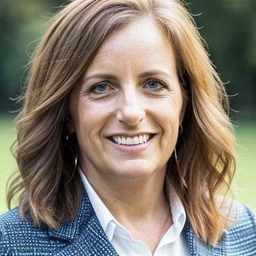
Krista Wojdak
Professor of Instructional Design and Technology, Appalachian State University
Workshop 9
Designing Learning Environments in an Agentic World: Coordinating Students, Instructors, and AI
Agentic AI systems are already capable of planning, executing multi-step tasks, and completing complex academic work with minimal human input—rapidly reshaping what is possible in higher education. Students, instructors, and institutions either already have, or soon will have, access to these systems. The question is no longer whether AI will be used, but how it can be harnessed in ways that align with core educational values. In this hands-on workshop, participants will explore how agentic AI reshapes the instructional ecosystem—curriculum, instruction, and assessment—and how our values as educators should guide decisions about its integration. Through targeted demonstrations of current agentic capabilities, participants will examine what these systems reveal about what our learning environments are actually asking of students and instructors, and where design changes can have the greatest impact.
Through structured, values-driven design exercises and peer collaboration, participants will analyze their own courses to identify where agentic systems might disrupt, enhance, or obscure learning processes. The workshop will explore how instructors can leverage agentic AI to expand their agency in course design, how to design assignments where agents make student reasoning and learning visible, how to recognize when AI integration risks short-circuiting the teachable moments that drive learning, and how agentic AI can make outcomes assessment more meaningful and actionable. Participants will leave with a practical workshop companion document, a redesigned assignment or course element, strategies for coordinating AI use across students and instructors, and a clearer understanding of how to advocate for institutional policies that support responsible, values-aligned AI integration.

Michelle Kassorla
Associate Professor of English, Georgia State University

Jonathan McMichael
AI Learning Solutions Specialist, Arizona State University