
The Real Work of Poetry
Students at Smith’s literary press are bringing books into the world
⚠️ You have free article remaining.
Log in or become a member for unlimited access.
It’s the last day of my fall course, The Chapbook in Practice: Publishing, at Smith College, and my students lean forward, murmuring excitedly as I walk up to the blackboard. They have just added their votes to the remaining titles in the poetry chapbook contest run by Nine Syllables Press, Smith’s poetry press. After two days of structured, intensive conversation about the submissions, we are using a form of instant run-off voting to choose the ten finalists. I start by erasing titles with no votes, then the fewest votes, until we have our finalists. The eighteen students break into applause.
The finalists will be sent to our 2025 final judge, poet Eugenia Leigh, to decide the winner, and the students in my spring course, The Chapbook in Practice: Design, will create covers for the selected manuscript. The author will ultimately choose which design will become the book’s cover. Gaining professional experience through a college or university literary press is as real as it gets for students.
“Having this press has made writing and creativity feel more accessible, especially as a psych major,” says student Ella Claire Moore. “I still want to write and see how that field works and meet people who’ve gone through this process, hold their work in my hands. It’s not happening somewhere distant—it’s happening right here on campus.”
Students who are part of literary presses engage in some of the foundational “values of the liberal arts–expanding their thinking, gaining independence,” says Jennifer Acker, editor in chief of The Common, a literary magazine based at Amherst College. “A lit mag or press provides a space for students to do that where they’re an active part of creating things and supporting authors instead of just receiving literature.”
I came to Smith College, a historic women’s college, through the Ada Comstock Scholar program, which allows nontraditional (older) students to enroll at Smith to finish their bachelor’s degree. I pursued a poetry concentration, which required two internships or comparable work experience. I interned at Perugia Press, a nonprofit poetry press in Massachusetts. One of my tasks was to count how many women had won major literary awards. The numbers were alarmingly low. On my own, I researched and found that none of the historic US women’s colleges had a currently operating professional literary press. This seemed like both a huge oversight and a huge opportunity: Starting a press at Smith would allow students to learn more about historically marginalized communities and offer writers another place to submit their work. It’s hard to win the Pulitzer Prize if you can’t publish your first book.
In my final months as a student, I pitched the idea of establishing a poetry press at Smith to Matt Donovan, the director of the college’s Boutelle-Day Poetry Center, which had considered starting a press many times but never had the resources to do so. But thanks to a generous alumna’s recent gift, we had those resources for the first time.
Now in the fifth year of Nine Syllables, my fall students are learning about the publishing industry and reading the three hundred manuscript submissions for our chapbook contest. We discuss craft, such as line endings and metaphors, and we also talk about how craft is inherently biased and subjective and how readers bring their own positionality and assumptions with them.
The fall class stretches students’ abilities to hold opposing truths (judging poetry is absurd, and our job is to judge these poetry manuscripts), their empathy (to try to approach each submission with a fresh and open mind, setting aside their own biases), and their stamina (each student will read more than fifty manuscripts by the end of the semester). My students know that the work they do in my class is real—we are collectively changing someone’s life by choosing their manuscript and turning it from a computer file into an actual book.
“It’s a way to contribute to the literary landscape in ways that extend beyond your own writing,” says David Haydon, who was editor in chief at Gold Line Press while a doctoral student at the University of Southern California. “When I’m frustrated with my own projects, it feels like I’m still doing something by bringing other people’s work into the world.”
My spring students learn Adobe InDesign, the standard software for book and magazine design, as well as the history of bookmaking and printing and how to market a book. We discuss how to respect the author’s wishes yet combine inspiration from the manuscript with our own creative visions. “It was very unique specifically because we were working with an artist,” says student Olivia Peyev. “I’ve never had a class that allowed me to do that.”
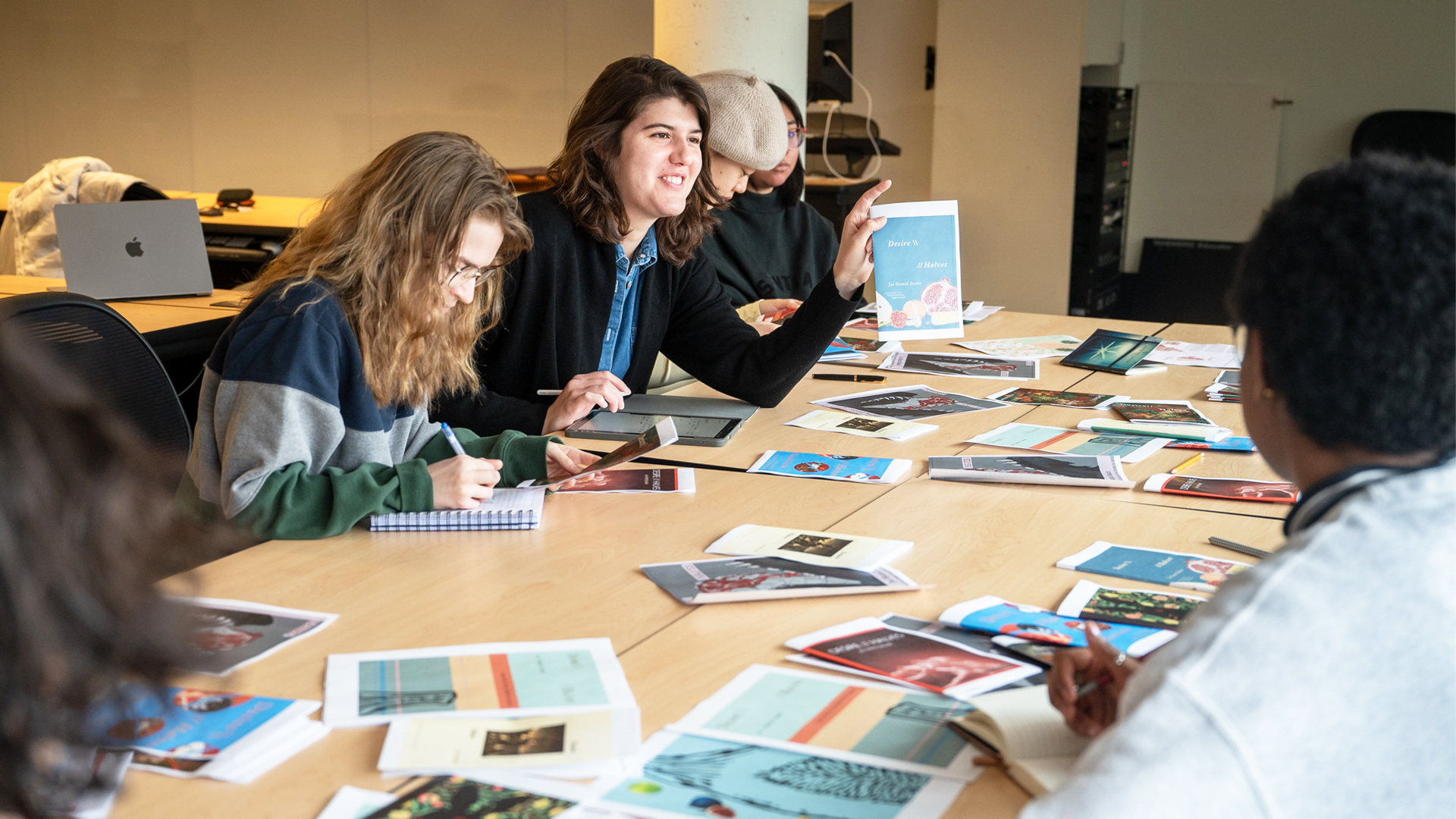
InDesign is a challenging, counterintuitive program, and many of my students are used to being good at things right from the start, so the class is also about learning how to be bad at something at first. “When I approach something, it has to be perfect the first time,” Peyev says. “This class taught me that in order for something to be good, it should simmer on the stove for a bit.”
At Literary House Press at Washington College, students create poetry broadsides (a single sheet printed with both imagery and text) using presses in the college’s print studio. “It gives students a different relationship to language, especially for poetry—you lay out the silences physically,” says James Allen Hall, Literary House’s editor in chief. “Space is a physical thing they put down when setting type—you can see that it changes the way they think.”
Peyev graduated in 2024 and now works as a marketing coordinator at an architecture firm in Boston. When she was seeking a job, she touted her InDesign skills and sent her chapbook cover design with every application. “In my interviews they would say they liked it and ask me to tell more about it,” she says. “When I was applying to these jobs, I was like, ‘Oh, I’ve done this before.’ I felt prepared for my current role.”
At a January 2026 faculty retreat, Smith’s provost, Daphne Lamothe, talked about how many STEM students work with the same team as part of a lab for most of their undergraduate career. This experience is so formative that when introducing themselves, many students will mention their lab name before saying their major. “How can you, as humanities professors and departments,” Lamothe posed to us at the retreat, “create opportunities for connection similar to STEM labs?”
I took Lamothe’s question seriously and reworked my spring syllabus, creating teams on the first day of class. Each student still develops an individual design but now they also work in teams to present on an InDesign skill and fulfill other assignments.
For 2026, Nine Syllables has added a new contest, the Tammis Day Prize for a full-length poetry book by a woman who is forty or above. It’s the only prize of its kind. “It’s really hard to get your foot in the door in publishing, so you might think you might as well not even try,” says Ella Claire Moore. “Nine Syllables feels totally against that, like why shouldn’t you try and do it? Learn this skill or submit your book and see what people think?”
Hall at Literary House points out that the creative opportunities of a press can help attract students to a campus. “Our printer loves to use kerosene to clean the ink from the press, and the students are like, ‘Oh our words are flammable,’ and I’m like, ‘Yes you’re making incendiary art,’ ” Hall says. “Our press is integrative learning, and you do something because you want to, not because you have to. We have a sense that we’re being stewards of history, a mission that’s bigger than ‘here’s your credit.’ ”
Nine Syllables remains the only professional literary press at a women’s college, a fact of which we are proud. But I would rather be proud to say that we are part of a thriving network, where every historic women’s college hosts a literary press and many other liberal arts colleges do, too. As we encourage our students that their voices matter, we can make that much more real with opportunities to steward other people’s voices into the world, printed right there on the crisp fresh pages of a new book.
Exclusive Content