Conference on AI and Higher Education
Plenary Sessions
Opening Plenary
Wednesday, October 28, 2026 / –
Leading Through Uncertainty: Institutional Strategy and Student Voice in the Age of AI
Higher education is currently facing unprecedented challenges but amid this context of uncertainty, a recent survey of AAC&U members found that their greatest concerns were associated with the implications of artificial intelligence for their institutions and how they advance their missions. This opening plenary will chronicle this broader landscape and set the stage for the conversations regarding AI and higher education that will follow at this conference.
AAC&U leaders will begin by examining the broader higher education landscape and the challenges institutions are navigating before turning to a panel with senior leaders about how their institutions are responding to AI and preparing for what comes next. The plenary will conclude with a student panel exploring students’ perceptions of AI’s influence in the classroom, the skills they believe they need to develop while in college, and how they anticipate AI shaping their lives after graduation.
Opening Remarks

Lynn Pasquerella
President, AAC&U
C. Edward Watson
Vice President for Digital Innovation, AAC&U
Senior Leaders Panel

Pearl K. Dowe
Senior Vice Provost for Academic Affairs, Emory University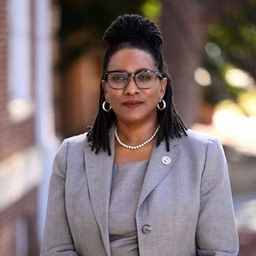
Charlene D. Gilbert
Provost and Senior Vice President for Academic Affairs, Clark Atlanta University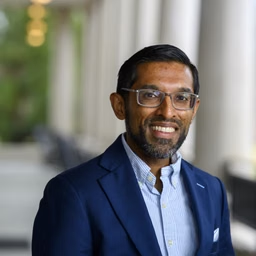
Sandeep Mazumder
President, Berry College
Nicolle Parsons-Pollard
Provost and Executive Vice President for Academic Affairs, Georgia State University
Leocadia I. Zak
President, Agnes Scott CollegeC. Edward Watson
Vice President for Digital Innovation, AAC&UModerator
A moderated student panel discussion will follow.
Thursday Plenary
Thursday, October 29, 2026 / –
Are We Asking the Right Questions about Human Thinking and AI?
AI is a new form of labor that is already changing learning, research, and work in higher education: flooding the world with synthetic content, but also raising expectations for speed, polish, and productivity. As technology challenges existing skills, it also invites us to ask what learning goals need to change: what forms of human judgment, interpretation, and reflection need to be cultivated more intentionally? AI has also exposed long-standing assumptions that our existing methods were really developing the critical thinking and reflection we value. Campuses have responded with new policies, task forces, and programs, but these are operational responses to an epistemological crisis. The future of higher education will depend less on how quickly campuses adopt AI than on whether they can clearly articulate the purpose of learning in a world where knowledge work is no longer exclusively human.
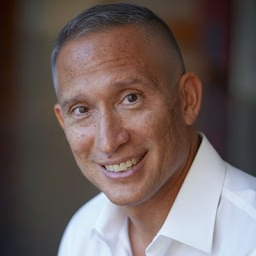
José Antonio Bowen
José Antonio Bowen has won teaching awards at Stanford and Georgetown, served as dean and president, has written over 100 scholarly articles, and appeared as a musician with Stan Getz, Bobby McFerrin, and others. He is the author of Teaching Naked (2012, awarded Best Book on Higher Education), Teaching Change (2021), and Teaching with AI: A Practical Guide to a New Era of Human Learning with C. Edward Watson (2024; 2nd edn 2026). Stanford honored him as a Distinguished Alumni Scholar (2010), and he has presented keynotes and workshops in 24 countries. In 2018, he was awarded the Ernest L. Boyer Award (for significant contributions to American higher education). He is a senior fellow for the American Association of Colleges and Universities and does consulting for a wide variety of Fortune 500 companies.
Closing Plenary
Friday, October 30, 2026 / –
Envisioning and Preparing for the Post-AI University
How much will the AI revolution transform higher education? In this session, we explore possibilities for the short- and medium-term futures. We start by analyzing the impact AI is having on the broader world, including technology, economics, politics, culture, and psychology. This closing keynote will then map those onto academia. Next, we will survey emerging trends in how colleges and universities have engaged with AI, from institutional strategies and challenges to classroom practice and pedagogy. We'll conclude by offering several scenarios for potential post-AI post-secondary educational futures. Attendees will then be charged with creating the future that best serves their institutions and their students.

Bryan Alexander
Senior Scholar, Learning, Design, and Technology Program; Georgetown University