2026 Conference on Global Learning
Proposal Details
The proposal submission period is now closed.
Developing and Submitting a Proposal
The online proposal form included the following fields:
- Session title formatted in title case and ready for publication in conference materials.
- Complete and accurate current contact information — including full name, professional title, institutional affiliation, email address— and role for each presenter.
- AAC&U lists presenters’ first names, last names, and middle names only. Please do not include “Dr.” or list abbreviated degree credentials after names in the names of presenters in conference materials.
- Please list only one presenter in the “Primary Presenter” role for each conference session proposal you submit. The primary presenter serves as the point of contact for conference communications and to complete tasks associated with conference preparation.
- Listed presenters will appear in alphabetical order in conference program materials. Presenters may opt to share their email contact information with conference attendees.
- All presenters must be registered for the conference by October 1, 2026 in order to appear on the conference program. Presenters who will only present at the virtual conference may choose to register for the virtual conference option only.
- All presentations must include registered in-person presenters, but virtual presenters may be included in in-person conference session proposals. Requests for virtual presenters during the in-person conference will be considered on a case-by-case basis as conference proposals are being reviewed. Decisions about virtual presenters for the in-person conference will be communicated with acceptance notifications in August 2026. Any approved virtual presenters for the in-person conference must register at the virtual conference rate by October 1, 2026.
- Conference track
- Preferred session format
- Please note that your conference session proposal may be accepted in an alternate format. The format accepted by conference reviewers will be noted in the session acceptance notification sent to the primary presenter via email in August 2026.
- Proposal abstract (Max. 400 Words): The abstract should describe the content and significance of the session and its format, how the session relates to the selected conference track, and how the audience will be engaged. Submissions should include examples of new findings, innovation, and evidence of success.
- Anticipated learning outcomes for participants (Max. 200 Words)
- Include up to four learning outcomes.
- Learning outcomes will not be included in conference program or materials, but will inform the review process.
- Background and evidence of the effectiveness of work being presented for consideration during review (Max. 250 words)
- For Ideation and Innovation Sessions, proposals should include a description of feedback benefits for your emerging or innovative session topic and how you arrived at this point in developing this concept, idea, or activity.
- Plan for participant engagement for consideration during review (not required for posters) (Max. 250 words)
- For Dialogues for Learning, submissions should include the guiding questions for the interactive part of your session.
- For Pre-Conference Strategy Sessions and Workshops, provide an outline of the session structure and describe the interactive components.
- Brief session description to be published in conference program materials (Max. 150 Words)
- The brief description will be published in the form in which it is submitted in the conference program and on the conference program website. Should your proposal be accepted, a conference attendee’s decision to attend your session will be based, in large part, on this description. It should be ready for publication at the time of submission, and as accurate and as compelling as possible.
- All session descriptions will be copyedited for style and content. A very limited window for edits to session descriptions will be available after conference acceptance notifications are distributed in August 2026 and before copyediting begins.
- Session “takeaways” to be published in conference program materials (Max. 75 Words): List up to three things you hope the participants will take away from this session. Descriptions should highlight what is distinctive and transferrable about the work you are presenting.
- Consideration of other session formats, if your proposal is not accepted in the format submitted.
- Presentation Modality: Please indicate whether you want to present virtually, in person, or are open to both.
Proposal Review Criteria
AAC&U strives to offer balanced, informative, and thought-provoking conferences focused on practical and theoretical approaches to global learning at the course, departmental, and institutional levels from across a broad spectrum of higher education contexts.
The proposal selection committee will include experienced academic professionals with a range of backgrounds and areas of expertise. Considerations will be made to ensure sessions address the scope of topics within the conference tracks. The following elements serve as proposal selection criteria:
- Relevance and significance to conference tracks
- Potential for practical, tangible, and transformative takeaways for conference participants
- Plans (appropriate to the session format) for involving participants in reflection, discussion, exercises, and other activities that will help them understand and apply the material
- The extent to which proposals reflect diverse perspectives, innovations, disciplines, and strategies for change (student voices and perspectives are encouraged)
Conference Tracks
This track focuses on strategies and models that address how global learning and community, civic, and democratic engagement are integrated to advance global learning and the public good in local, global, and international contexts.
This track explores how institutions are making the case for and advancing global learning in today’s politicized environment, as well as institutional adaptations and program alignment to address changing student and curricular needs.
This track features approaches that elevate and integrate COIL and Virtual Exchange across institutions, model sustainable practices, and integrate COIL and Virtual Exchange with career readiness initiatives.
This track explores how global learning is connected to career and future readiness through course design, connections with career services and the professions, and other innovations.
This track explores how AI, technology, and other innovations are advancing, enhancing, and expanding global learning.
This track centers on practices, considerations, and ethical frameworks for sustainability in global learning for the present and the future.
This track highlights how institutions are developing and implementing promising practices in program and course design for global learning for current and future faculty and administrators of all types.
Session Types
Dialogues for Learning provide time for an examination of global learning topics through iterative sharing of practices, expertise, and experiences. They provide an opportunity to work through issues, ideas, and challenges from multiple perspectives, engage in problem solving, and explore new ideas. Presenters will dedicate at least 20 minutes to discussion.
(60 minutes In-Person and Online)
Innovation Sessions feature innovative practices that have emerged as global learning has been reframed in response to the disruption of the global pandemic and/or institutional efforts to make higher education practices more equitable. Each session consists of multiple presentations of equal length, with shared time at the end of the presentations for questions and feedback.
(15 minutes In-Person and Online)
Ideation Sessions feature emerging practices, research, concepts, and ideas that advance global learning at different stages of development. These sessions offer space for engagement and feedback on new or refined efforts that have emerged with differing degrees of success. Each session consists of multiple presentations of equal length. Each 15-minute presentation will be followed by 15 minutes of feedback and engagement.
(15 minutes In-Person and Online)
Panel Discussions allow for conversation with up to four panelists on a conference theme. During these discussions, panelists should offer different perspectives on the topic (e.g., cross-institutional, institutional role, programmatic, disciplinary, modality). Priority will be given to proposals with representation from multiple institutions and/or institutional roles.
(60-minute In-Person and Online)
Poster, Data Visualization, and Visual Arts Representation Sessions are organized around visual displays of research, models, materials, and/or visual arts. A poster session provides an opportunity for presenters to talk with attendees about how to apply findings to their own work and highlight visual representations of global learning through artistic expression.
(In-Person)
Pre-conference Strategy Sessions are designed to guide participants as they develop plans of action for significant work at the level of the course, program, or institution. Presenters should provide resources and templates to help participants structure their planning. There will be opportunities for discussion and feedback. These sessions will be held as preconference workshops.
(150 minutes In-Person)
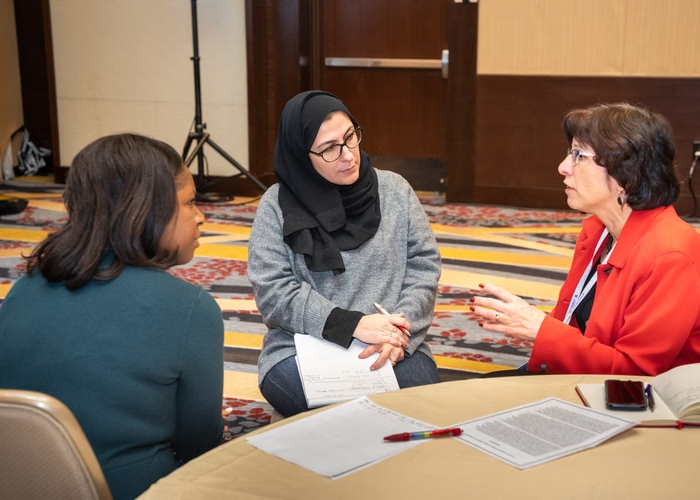
Roundtable Discussions allow for conversation among a small group of colleagues. Presenters are assigned a table for the duration of the session. Participants may move between tables and are prompted to do so every twenty minutes.
(20 minutes In-Person and Online)
Workshops provide an interactive environment for conference attendees to bridge theory and practice and to deeply examine, explore, and/or experience relevant theories and implementation strategies in the context of real-world issues.
(75 minutes In-Person and Online)