GCTA | University of Bath (UK) & Elon University (US)

⚖️🌿Peace and Justice
GCTA Fulbright Faculty Fellows
Dr. Sandy Marshall
Elon University (US)
Dr. Pete Manning
University of Bath (UK)
Instructional Designers
Becky Kloepfer (Elon University, US)
Marie Salter (University of Bath, UK)
International Administrators
Nick Gozik (Elon University, US)
Emily Richards (University of Bath, UK)
Courses
Foundations of Peace & Conflict Studies (Elon University, US)
Atrocities, Conflict, Human Rights (University of Bath, UK)
COIL Module
Framing the Future of Conflict & Peace
By confronting the implications of AI and autonomous technologies in global conflict, students develop the collaborative and ethical leadership skills required for a rapidly changing world.
The Global Challenge

Emerging technologies are reshaping the landscape of conflict, peacebuilding, and justice at unprecedented speed. Artificial intelligence, autonomous weapons systems, drone warfare, social media, and deepfake technologies are transforming how conflicts are initiated, represented, and resolved. The United States and the United Kingdom hold significant historic and contemporary roles in both the creation and resolution of conflict, as well as in technological innovation. Students at both institutions are coming of age amid rapid geopolitical shifts and technological revolutions that will define their personal and professional futures. Yet traditional peace and conflict frameworks often struggle to keep pace with these accelerating developments. Addressing contemporary questions of justice and global security requires interdisciplinary, collaborative approaches that combine ethical reasoning, technological literacy, and intercultural dialogue.
The Partnership Response
This VE/COIL collaboration connects Foundations of Peace & Conflict Studies at Elon University with Atrocities, Conflict, Human Rights at the University of Bath under the shared theme Framing the Future of Conflict & Peace. The six-week exchange brings US and UK students together to critically examine how emerging technologies shape contemporary conflict and peace processes.
From the outset, faculty recognized the need to move beyond dense historical case studies toward dynamic, contemporary questions that reflect “the moment.” Working closely with instructional designers, the team developed a structured collaborative module that enables students to analyze ethical, cultural, and disciplinary perspectives on technology’s impact on conflict, justice, and peace.
The shared learning outcomes emphasize:
Critical evaluation of diverse perspectives on emerging technologies
Formulation of evidence-based positions on issues such as AI, drones, autonomous weapons, and social media
Effective collaboration in multidisciplinary and multicultural teams
Module Design
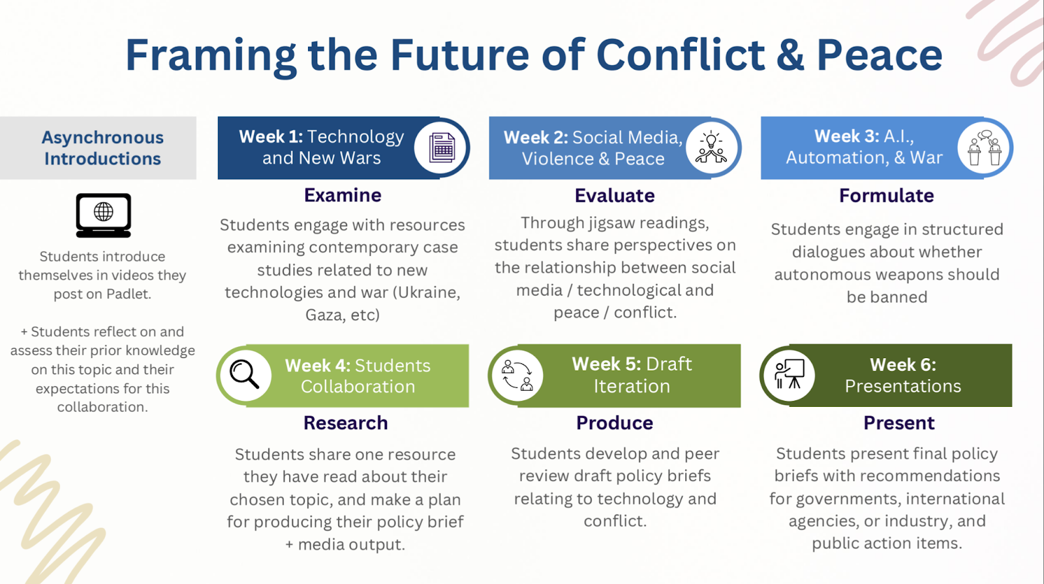
The exchange begins with asynchronous introductions, followed by integrated synchronous sessions in which students engage with contemporary conflict case studies. Using the jigsaw reading technique, students analyze key resources and work toward structured dialogue on questions such as whether autonomous weapons should be banned.
Building on these discussions, cross-institutional teams collaboratively develop and peer-review policy briefs addressing the implications of emerging technologies for governments, international agencies, industry, and civil society. Students present their recommendations to the broader group, articulating both policy proposals and public action steps.
Assessment includes:
Formal policy briefs
Group presentations
Weekly reflective submissions (written or audio)
A final summative reflection assessed according to institutional criteria
Through this process, students practice collaborative reasoning across national contexts while navigating ethical ambiguity and competing priorities in rapidly evolving technological environments.
Institutional Alignment
The partnership has strengthened institutional capacity to embed COIL within broader strategic priorities at both universities.
At the University of Bath, the project aligns with goals to:
Expand high-impact international partnerships
Advance intercultural and digital competencies linked to employability
Embed sustainability through low-carbon approaches to global engagement
Increase inclusive access to international learning experiences
At Elon University, the collaboration supports both the University Strategic Plan and Global Strategic Plan by:
Further internationalizing the curriculum through scalable global engagement
Expanding sustained intercultural learning opportunities
Advancing access and inclusion in global education
Strengthening long-term global partnerships
The module also aligns closely with Elon’s Core Curriculum by advancing curiosity-driven inquiry, research skills, global perspective, ethical reasoning, critical thinking, and professional communication.
Long-term Vision
Beyond immediate student outcomes, this collaboration serves as a model for sustained, technology-focused COIL engagement within peace and conflict studies. By integrating contemporary technological dilemmas into cross-border dialogue, the partnership demonstrates how virtual exchange can prepare students to confront the ethical and geopolitical challenges of the digital age.
The team anticipates continued refinement and embedding of the module as a cornerstone of their respective courses, contributing to institutional strategies for internationalization, inclusive global learning, and digitally mediated collaboration.
Learn More
Explore the Global Challenges Teaching Awards and how these projects fit into AAC&U's broader VE/COIL initiative.