2026 Conference on Global Learning
Pre-Conference Strategy Sessions
Pre-Conference Strategy Session One
First-Year Abroad: High-Impact Practice and Strategic Enrollment Management Initiative
Research shows that students involved in high-impact practices (HIPs) enjoy higher levels of learning success. First-year study abroad allows institutions to create and implement global educational opportunities for first-year students, introducing international experiences early in their college experience.
This strategy session will detail the discussions and decision-making processes at two campuses that launched first-year study abroad opportunities and will share data showing how participants grow as individuals, develop an affinity for their campus, and actively engage in high-impact educational experiences. We’ll discuss how the HIPs of “Common Intellectual Experience,” “Global Learning,” “First-Year Experiences,” “Learning Communities,” and “Community-Based Learning” come together. We’ll also discuss the challenges and growing pains these institutions encountered and how they addressed them.
We’ll wrap up with a discussion of how such an initiative could be developed on your campus, which model might work for your institution, what challenges may need to be overcome, and what benefits the initiative could provide.
Key Takeaways
Participants will
- examine how first-year study abroad aligns with high-impact practices;
- assess whether a first-year study abroad program could benefit their campus;
- identify potential campus roadblocks and strategies for addressing them; and
- determine where an initiative could begin, where it could be housed, and what next steps are needed.
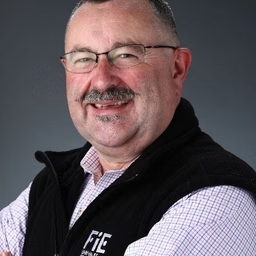
Grahaeme A. Hesp
Senior Director of Institutional Relations, FIE: Foundation for International Education
Pre-Conference Strategy Session Two
From Global Learning to Global Action: Using the United Nations Sustainable Development Goals to Engage Faculty and Students Across Campus
Global learning and the United Nations Sustainable Development Goals (SDGs) are mutually reinforcing frameworks for preparing students to navigate an interconnected world. This interactive strategy session will explore how colleges and universities can use the SDGs to advance global learning through a variety of pathways for faculty and student engagement. Drawing on emerging scholarship and examples from the University of California, Davis, and other institutions, presenters will share strategies for faculty development, curriculum redesign, interdisciplinary collaboration, student leadership, internships, and first-year experiences that connect global issues with local action.
Participants will examine approaches for aligning global learning and SDG initiatives with institutional priorities, map existing resources and opportunities on their campuses, and identify strategies for expanding engagement. The session is designed for faculty, administrators, and other higher education professionals seeking adaptable models for integrating global learning and the SDGs into their institutional contexts.
Key Takeaways
Participants will
- apply the SDGs as a framework for advancing global learning;
- explore strategies for engaging faculty and students through the SDGs; and
- develop an action map of campus resources, partnerships, and opportunities for strengthening global learning.
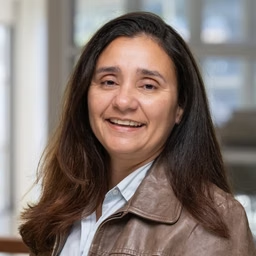
Esther L. DeLozier
Assistant Director of Partnerships and Faculty Engagement, University of California-Davis

Jolynn Shoemaker
Senior Director of Global Engagements, University of California-Davis
Pre-Conference Strategy Session Three
Harnessing the Global Learning Ecosystem for Internationalization Assessment and Planning
The Global Learning Ecosystem (GLE) model is a paradigm that focuses internationalization efforts on achieving global learning outcomes, whether at the institutional or departmental level. The accompanying GLE assessment rubric and planning tool have been field tested across different types of institutions and within individual departments. The GLE fosters intentional integration across the campus community to strengthen stakeholder engagement and impact.
Session participants will first learn about the GLE model and then use the assessment rubric to consider how the model and planning tool can support global learning goals for their institution or department.
Key Takeaways
Participants will
- examine how the GLE model can support internationalization efforts;
- use the GLE assessment rubric and planning tool; and
- exchange strategies for applying the planning tool within their institution or department.

Linda Drake Gobbo
Faculty Emerita, SIT Graduate Institute
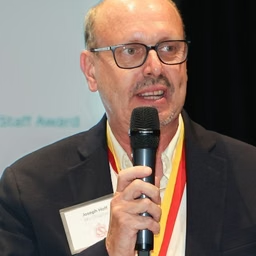
Joseph G. Hoff
Director for the Office of Global Learning, The University of North Carolina at Charlotte

Whitney Wotkyns
Former Director of LL.M. and International Student Services, Northeastern University

Register Today!
Attend a pre-conference strategy session and jump-start your conference experience.