Podcast
Shawn Laatsch, University of Maine - The Sky is Falling and Sonic Booms
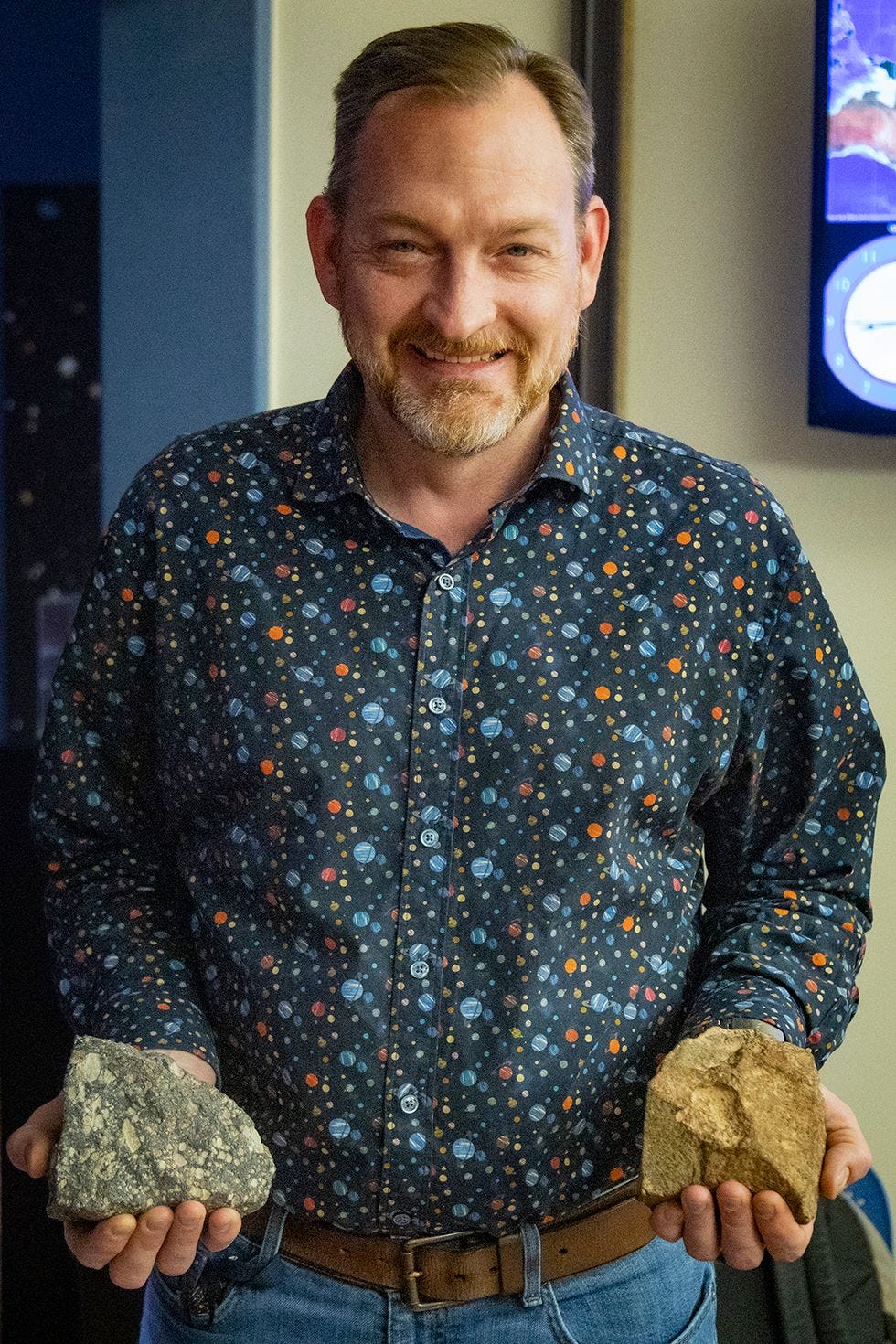
Why do meteors create sonic booms?
Shawn Laatsch, director of the Versant Power Astronomy Center & Jordan Planetarium at the University of Maine, explores this.
Faculty Bio:
Mr. Shawn Laatsch is the director of the Versant Power Astronomy Center and Jordan Planetarium at the University of Maine. He oversees all planetarium and observatory operations. Over his career he has presented over 10,000 planetarium shows, led educational workshops, and has been an invited guest lecturer on astronomy and planetariums in Argentina, Brazil, China, Germany, Greece, Italy, Japan, Mexico, New Zealand, and Russia. He is recognized as a pioneer in the use of digital dome technology and innovations in the field. Shawn installed the world’s first 3D stereoscopic planetarium at the ‘Imiloa Astronomy Center of Hawaii. He has consulted on the planning and building of numerous planetarium projects worldwide and recently evaluated the Iziko Planetarium in Cape Town, South Africa for its planned upgrade to digital in late 2015.
In 2023 he was recruited by NASA to be a regional coordinator for the CATE (Continental American Telescopic Eclipse) citizen science project. This project is focusing on measuring the Sun’s corona during totality and education around solar eclipses. Laatsch led statewide education and public outreach efforts in Maine for the Total Solar Eclipse on April 8, 2024. He gave over 40 media interviews and hosted the governor’s safety briefing. As part of the NASA project, he trained teams to collect data in Maine, Vermont, New Hampshire, and New York. Laatsch has participated in 5 total solar eclipses and helped students and the public view them safely.
Shawn served as an executive officer of the International Planetarium Society, Inc. the world’s largest organization of planetarium professionals from 1997-2020 serving as treasurer for 18 years and then a 6-year presidential term. In 1998 he was inducted as an International Planetarium Society Fellow, for his work in promoting astronomy education.
Originally from Wausau, Wisconsin, he started his planetarium career at the Wausau West High School Planetarium in 1984 as a student. While there he built telescopes and became president of the school astronomy club. Shawn has extensive planetarium experience in public, school, and university facilities. He served as planetarium director for the Arthur Storer Planetarium in Maryland, the Gheens Science Hall & Rauch Planetarium in Kentucky, and the Imiloa Astronomy Center of Hawaii where he worked to bring new astronomical datasets into the planetarium environment. While in Hawaii he also did a weekly radio program called Stargazer on Hawaii Public Radio His most recent position before coming to Maine in January 2016 was as director and site manager for the Infoversum, a 3D digital dome in Groningen, Netherlands where he was recruited to supervise its construction, installation of technical equipment, and trained staff for opening the center.
In 2004, Shawn was selected as a NASA JPL Solar System Ambassador. In 2006 he was asked by NASA SEARCH to be a special presenter on cultural astronomy education at COSPAR (Committee on Space Research) in Beijing, China. In 2008 he received the International Planetarium Society’s highest honor, the Service Award for dedication to the planetarium field. In 2010 he was elected to the Board of Directors for the Astronomical Society of the Pacific and received the Tanaguchi Award for Excellence and Innovation in Teaching from the University of Hawaii at Hilo. Shawn initiated and led the production of Two Small Pieces of Glass, a planetarium program for the International Year of Astronomy which has become one of the most distributed planetarium shows in the world. In 2011 he was appointed chair of the Mauna Kea Observatories Outreach Committee. In 2017 he was inducted by the Wausau Public School System into their 25 Year Society as a former graduate with 25 years or more of service and significant contributions in the field of astronomy education. In 2024 the University of Maine presented him with the Outstanding Professional Employee Award for his outreach activities around the solar eclipse and astronomy.
He has taught undergraduate astronomy courses at the University of Louisville, East Carolina University, Pitt Community College, the University of Hawaii at Hilo and the University of Maine using traditional and online methodologies. Additionally, he developed a number of special techniques for using the digital planetarium to teach undergraduate astronomy in the dome.
Shawn has a passion for cultural and historical astronomy and sharing the wonders of the universe with people of all ages. In his free time, he enjoys the great outdoors and traveling with his wife Kim and two dogs.
Transcript:
We humans live out our lives on a planet that is constantly sweeping through a cosmic ocean littered with ancient debris from the formation of the solar system. For the most part, our world glides silently through space, shielded by Earth’s thin atmosphere.
Occasionally, however, the rest of the universe reminds us of its presence with stunning, visceral clarity. So far in 2026 we have had four major meteorite falls with two of them accompanied by sonic booms.
NASA and NOAA satellites were able to identify the culprits as a small meteorites measuring roughly 3 to 5 feet (1 to 2 meters) across, screaming through space at an astonishing speeds. Friction between the meteor and the increasingly dense air quickly turned the kinetic energy of the rock shooting through the sky into blistering heat. At an altitude of roughly 40 miles (60 kilometers), the immense heat and pressure overcame the structural integrity of the meteor, causing it to fragment in a brilliant flash.
The breakup of these objects released a staggering burst of energy equivalent to hundreds tons of TNT.
When an object travels through the air at speeds faster than sound, which is 761 mph (1,225 kph), it creates a shock wave creating a thunderous clap, or sonic boom. While the majority of the rock vaporized, the remaining fragments rained down harmlessly to the surface of our planet.
So, are you in any imminent danger from meteors? The mathematics of the cosmos provide profound reassurance. The statistical odds of being struck by a meteorite are vanishingly small.
But when pieces do break through and land on our planet, they offer scientists a rare, tangible connection to the beginning of the solar system.
While the sky might not literally be falling, occasionally it does provide some spectacular views and sound from these meteorites.