Podcast
Murugan Anandarajan, Drexel University - What Employers Really Look For
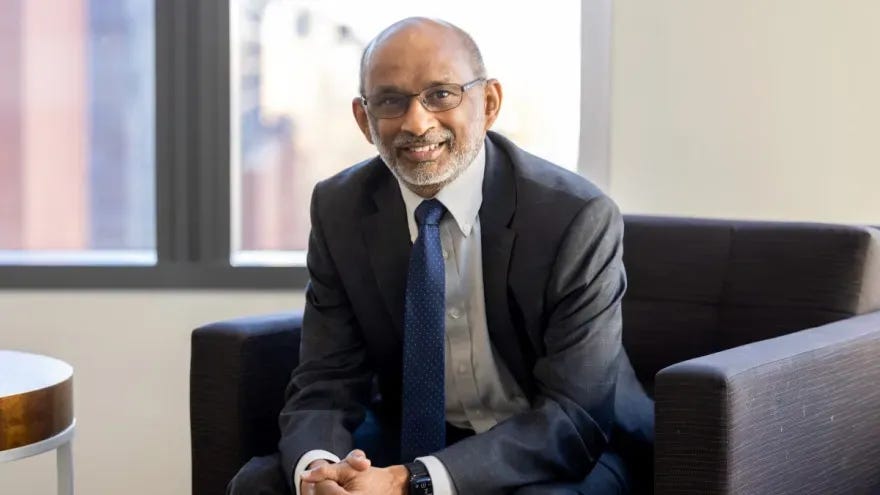
Employers may look for different things on resumes than you might think.
Murugan Anandarajan, professor of decision sciences at Drexel University, discusses this.
Faculty Bio:
Murugan Anandarajan, PhD is Vice Dean and Professor of Management Information Systems at Drexel University’s LeBow College of Business, where he also serves as Academic Director of the Dornsife Office for Experiential Learning and the Center for Applied AI and Business Analytics. He founded the Career Readiness Center.
His research focuses on artificial intelligence, analytics, digital transformation, and the future of work, with publications in leading journals including Decision Sciences, Journal of Management Information Systems, and Journal of International Business Studies. His work has been supported by the National Science Foundation, the U.S. Department of Justice, and the National Institute of Justice, and has been featured in outlets including The Conversation, Bloomberg Businessweek, Forbes, and Fast Company.
Transcript:
What makes someone stand out when they’re applying for their first professional job?
With all the attention on AI, it’s easy to think technical skills matter most.
But when my colleagues and I surveyed more than 600 employers about what they look for in new graduates, we heard something different.
They want people they can trust.
Technical skills are important, employers also want someone who is dependable, professional, and works well with others.
In fact, reliability and professionalism were the two highest-rated qualities in our study. They ranked ahead of every technical skill we measured.
And the employers’ comments told us why.
One employer talked about rejecting applications because of poor writing. Others emphasized curiosity and a willingness to learn.
They weren’t simply looking for people who knew the latest tools.
They were looking for people who could grow.
That has important implications for colleges and universities.
Preparing students for work isn’t just about teaching knowledge. We need to give students real chances to tackle new problems, work with others, and see how a workplace really runs. Internships and experiential learning provide those opportunities.
One finding from the study has stayed with me.
Employers aren’t just hiring for what someone knows today.
They’re hiring for what that person can become.
And I think that’s one of the most important lessons for anyone starting a career.