Podcast
Charles J. Dimitroff, Florida International University - Glycoengineering to Improve Cancer Immunotherapy

On Florida International University Week: We’re learning more about how to treat blood cancers.
Charles J. Dimitroff, professor of cellular and molecular medicine, explores new approaches.
Faculty Bio:
Charles J. Dimitroff, Ph.D. is a global leader in the study of sugars, known as glycobiology, and is highly motivated to translate glycobiological findings to help cure diseases and improve the overall health of humans. His research focuses on understanding how complex sugars or ‘glycans’ regulate immune and cancer cell functions with the goal of developing new approaches to boost the immune system to fight diseases and to treat cancer progression. As an NIH-funded investigator for more than 25 years, his efforts have helped identify the nature and impact of glycans on inflammation and cancer, while operating one of the most reputable translational glycobiology programs in the world.
Dimitroff studies the nature of lectin – carbohydrate interactions and their impact in inflammation and cancer for more than 3 decades. He has a unique knowledge-base on the glycobiological (glycome) mechanisms relating to tumor biology, metastasis, and adaptive immunity, and is highly skilled in performing pre-clinical investigations on how glycome-related molecules contribute to the pathogenesis of inflammation and cancer. He conducts both in vitro and in vivo experiments designed to characterize the identity and function of lectins and their carbohydrate-binding ligands on leukocytes and cancer cells.
Transcripts:
In 2026, more than 67,000 Americans are expected to be diagnosed with leukemia, and more than 20,000 will be diagnosed with lymphoma, another type of blood cancer.
Advances in medical technology have transformed how doctors treat blood cancers.
CAR-T therapy is one of these treatments. It helps fight cancer using a patient’s own immune cells. However, the cancer fights back.
Cancer behaves like a gated community. It has its own residents, rules and security systems.
Together, they create what scientists call the tumor microenvironment.
This harsh environment can exhaust CAR-T cells, so they shut down before they can finish their job.
My research team discovered a way to give these cancer-fighting cells a protective shield.
While studying blood samples from both healthy volunteers and patients with lymphoma, my team found that those with cancer had high levels of a protein called galectin-3. This weakens CAR-T cells.
That’s where glycoengineering comes in.
This method changes the sugar coating of CAR-T cells, making them more resistant to the harsh tumor environment. This enhanced sugar coating acts as a shield against the tumor.
In preclinical studies, tumors shrank significantly.
Compared with conventional CAR-T therapy, the number of CAR-T cells doubled. Their survival time also increased, allowing the cells to attack the cancer longer.
Our research shows that the fight against cancer is stronger than ever. The next step is to determine whether these enhanced CAR-T cells can be used to fight cancers beyond lymphoma, including ovarian cancer.
Read More:
[The Conversation] - Killing cancer requires immune cells to infiltrate tumors’ hostile microenvironment – sugar shields can help them break in
[ScienceDirect] - Protecting the sugar coat on anti-tumor T cells to conceal destruction by tumor microenvironmental landmines
[Frontiers] - Glycoengineering CAR-T cells to overcome galectin-3-mediated immunosuppression
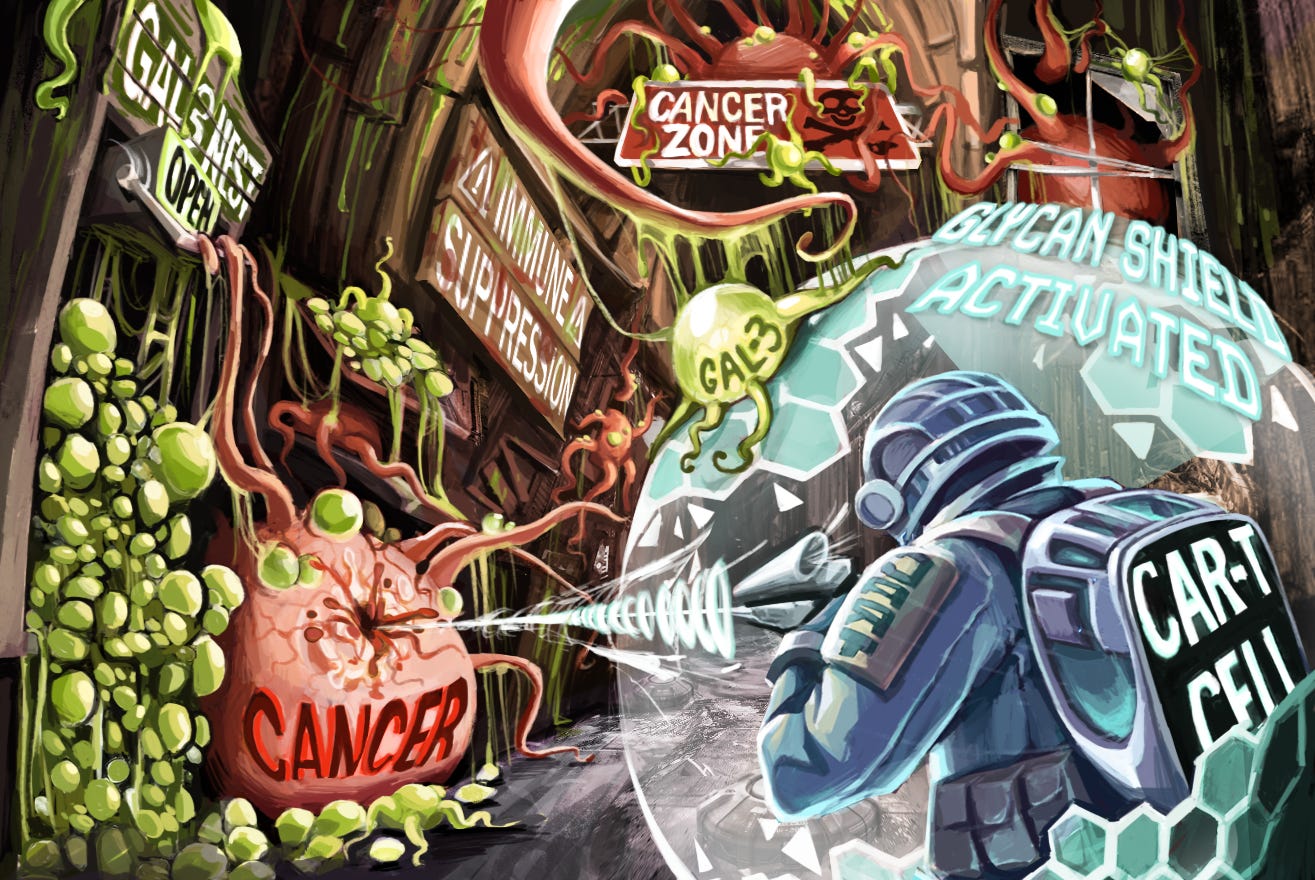
Original artwork by FIU student Lulu Perez